





The Galaxy's Most Common Stars
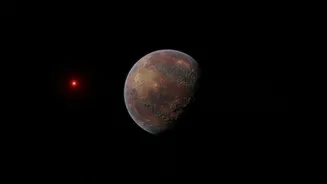
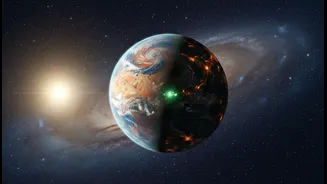
To understand why GJ 3378b is so special, we first need to talk about its parent star. It’s a red dwarf, the most common type of star in our Milky Way galaxy, making up about 70% of the stellar population. These stars are much smaller, cooler, and dimmer
than our Sun. Because they are cooler, a planet would need to orbit much closer to a red dwarf to stay warm enough for liquid water to exist on its surface—a region known as the 'habitable zone'. On paper, this sounds promising. With so many red dwarfs hosting so many planets, the galaxy should be teeming with potentially habitable worlds. However, there’s a violent catch.
A Dangerous Neighbourhood
Red dwarf stars are notoriously ill-tempered, especially in their youth. They are known for unleashing powerful stellar flares and intense streams of radiation, far more violent than anything our Sun produces. For a planet orbiting in the close-in habitable zone, this is a major problem. This constant bombardment of high-energy particles can effectively sandblast a planet’s atmosphere away over millions of years, leaving behind a barren, airless rock. This has long been the great paradox of red dwarf systems: the very place a planet needs to be for warmth is also the most dangerous, potentially making true habitability incredibly rare.
Meet the Survivor: GJ 3378b
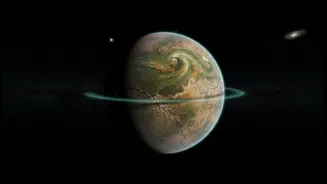
This is where GJ 3378b enters the picture. Recent observations confirmed its existence and gave scientists a much clearer picture of its properties. Initial estimates suggested it was a large, potentially gassy world, but new data reveals it has a mass just 2.3 times that of Earth, making it very likely a rocky 'super-Earth'. More importantly, its 21.5-day orbit places it comfortably within its star's habitable zone, receiving about 90% of the energy Earth gets from the Sun. It’s in what astronomers call the 'sweet spot' for temperature.
Life on the Cosmic Shoreline
What makes GJ 3378b a crucial scientific target is its precise location. Scientists have a concept called the 'cosmic shoreline'—a theoretical boundary around a star. A planet orbiting inside this line is likely too close and will have its atmosphere stripped away by stellar radiation. A planet outside this line might be able to hold on to its precious blanket of air. GJ 3378b orbits right at the edge of this shoreline. This makes it the perfect test case to see if the theory holds. Did it lose its atmosphere to its parent star's fury, or did it manage to survive? The answer could redefine our understanding of planetary habitability across the galaxy.
What Scientists Hope to Learn
For now, we don't know if GJ 3378b has an atmosphere. The planet was discovered by measuring the gravitational wobble of its star, not by watching it pass in front—a method that allows for atmospheric analysis. Answering that question will likely require the next generation of powerful instruments, such as the planned Habitable Worlds Observatory. But the discovery is still a landmark. By studying this one planet, scientists can test their models of atmospheric erosion and planetary resilience. If it does have an atmosphere, it would be a huge boost for the prospect of finding life around the galaxy’s most numerous stars. If it’s bare, it will help researchers refine where, and where not, to look for other Earth-like worlds.