
The Vision: A River-Led Logistics Revolution
India has an extensive network of rivers, canals, and backwaters, yet they account for a tiny fraction of its total freight movement—less than 5%. To change this, the government enacted the National Waterways Act, 2016, identifying 111 waterways for development.
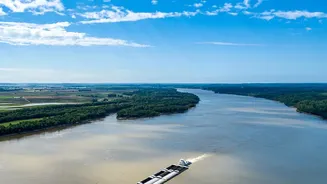
The flagship effort is the Jal Marg Vikas Project (JMVP), which focuses on augmenting the capacity of National Waterway 1 (NW-1), the 1620 km stretch of the Ganga-Bhagirathi-Hooghly river system from Prayagraj to Haldia. The goal is to create a cost-effective and environmentally sustainable alternative to congested road and rail networks, aiming to increase the modal share of inland water transport (IWT) from 2% to 5% by 2030.
Understanding Door-to-Door Journey Time
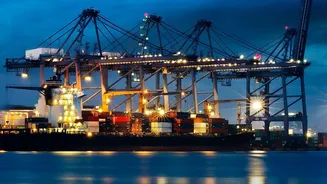
The term "door-to-door" is crucial. It’s not just about how long a vessel takes to travel on the water. A real-world journey involves multiple stages: first-mile transport from the factory to a riverside terminal, the main water transit, and last-mile transport from the destination terminal to the final warehouse or buyer. The waterways plan hinges on creating a seamless multi-modal transport network. This means building modern terminals, like those in Varanasi, Sahibganj, and Haldia, that are integrated with road and rail corridors, allowing goods to switch between transport modes efficiently. The total journey time, therefore, depends on the efficiency of these transfer points as much as the speed on the river itself.
Waterways vs. Road and Rail: It’s Not About Speed
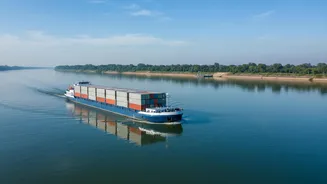
When comparing journey times, it's a mistake to focus solely on speed. Vessels on rivers are inherently slower than trucks or trains. However, their advantage lies in efficiency and consistency for bulk cargo. A single 2,000-tonne vessel can replace roughly 125 trucks, drastically reducing road congestion. While a truck might get stuck in traffic and a train has to contend with a crowded network, a waterway offers a clearer, more predictable path for large volumes of goods like coal, cement, food grains, and fertilisers. For example, a government statement noted a target transit time of 14 days between Kolkata and Varanasi on NW-1. This may seem slow, but for non-perishable bulk goods where cost and reliability trump speed, it becomes a compelling option.
The Real Calculation: Cost and Efficiency
The primary driver for shifting to waterways is economics. Water transport is significantly more fuel-efficient; one litre of fuel can move 105 tonne-km by water, compared to 85 by rail and just 24 by road. This translates into major cost savings. According to some estimates, water transport can be 60% cheaper than road and up to 30% cheaper than rail for certain types of cargo. While rivers meander, making the actual distance longer than by road or rail, the overall cost per ton for bulk goods often comes out lower. This cost advantage, combined with reduced emissions and the ability to move oversized cargo, forms the core value proposition of the waterways network.
A Journey on NW-1: The Ganga Expressway
National Waterway 1 serves as the backbone of this vision, connecting the industrial and agricultural heartlands of Uttar Pradesh, Bihar, Jharkhand, and West Bengal to the ports of Haldia and Kolkata. The Jal Marg Vikas Project has focused on developing the necessary infrastructure, including multimodal terminals, a new navigation lock at Farakka, and river information systems to ensure year-round navigation for vessels up to 2,000 tonnes. The development of NW-1 is designed to help industries in northern India bypass congested land routes and gain more direct and cheaper access to international sea lanes via the eastern ports.
Challenges on the Waterway Path
The expansion is not without significant hurdles. A primary challenge is maintaining adequate water depth throughout the year, as many rivers have seasonal variations in water levels. This necessitates constant and costly dredging, which raises environmental concerns. Heavy siltation, especially in rivers like the Ganga, further complicates maintenance. Furthermore, the infrastructure for first and last-mile connectivity is still developing, and there are reports of under-utilisation of new terminals due to a lack of return cargo and limited private sector participation. Ensuring the project's long-term viability requires overcoming these operational and logistical bottlenecks.