


The First Clue: The Sighting
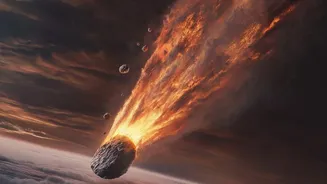
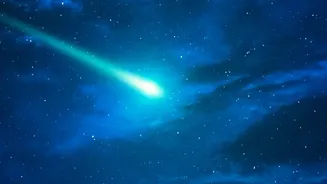
The investigation begins the moment a meteoroid hits Earth's atmosphere. Traveling at incredible speeds, it compresses and heats the air in front of it, creating the bright streak of light we call a meteor or 'shooting star'. Today, networks of automated,
all-sky cameras are positioned around the globe, acting as silent witnesses. Projects like the Desert Fireball Network (DFN) and Cameras for Allsky Meteor Survey (CAMS) constantly watch the skies. When a fireball appears, multiple cameras capture its journey. Even footage from dashboard cameras and security systems can provide valuable data, as was the case with the Chelyabinsk meteor in Russia in 2013. These recordings are the crucial first pieces of evidence, capturing the meteor's path relative to the fixed background of stars.
Triangulation: Pinpointing the Path
With observations from two or more locations, scientists can perform triangulation. Think of it like basic geometry on a cosmic scale. By comparing the apparent path of the meteor from different viewpoints, astronomers can precisely calculate its trajectory through the atmosphere — its height, angle of entry, and direction. The distance between the observation stations provides a baseline, allowing them to construct a triangle with the meteor's path and determine its exact location at any given moment of its fiery descent. This step turns a fleeting streak of light into a well-defined flight path through our atmosphere.
Calculating Speed and Deceleration
Knowing the path isn't enough; scientists also need to know how fast the meteoroid was moving. By analysing video footage frame by frame, they can measure the meteor's velocity. More importantly, they calculate how much it slowed down due to atmospheric drag. This deceleration is critical because it helps them estimate the object's initial velocity just before it hit the atmosphere. Sophisticated software models take into account factors like the meteor's brightness, which relates to its size and how it breaks apart, to refine this pre-entry speed. This initial velocity is a key parameter for the next and most crucial step: calculating its orbit.
Rewinding the Clock: The Original Orbit
Once astronomers have the meteoroid's pre-entry velocity and trajectory, they can perform a kind of celestial rewind. Using the laws of gravity and orbital mechanics, they calculate the path the object took through the solar system before its encounter with Earth. This process involves running complex computer simulations that account for the gravitational pull of the Sun and other planets. The calculation reveals the shape of the meteoroid's orbit—whether it was a near-circular path similar to an asteroid or a highly elongated one typical of a comet. This backward calculation effectively gives the space rock a return address.
Finding the Cosmic 'Parent Body'
The calculated orbit is the final clue that often points to the meteoroid's origin. By comparing the reconstructed orbit with the known orbits of asteroids and comets, scientists can often find a match. For example, they can determine if the rock came from the main asteroid belt between Mars and Jupiter, or if it was a piece of debris shed by a specific comet. In some cases, the chemical composition of the meteorite (if it survives to the ground) can be matched to a specific 'parent body'. For instance, analysis has linked certain meteorites to the asteroid Vesta, and others to Mars and the Moon, based on unique chemical and isotopic signatures.