






Why Our Urban Feet Are Suffering
From the moment we wake up, our feet are typically encased in shoes and walking on flat, hard surfaces like pavement, tile, and hardwood. While modern footwear provides protection, it can also act like a cast, restricting the natural movement of the 26
bones, 33 joints, and over 100 muscles, tendons, and ligaments in each foot. This lack of stimulation can lead to weakened foot muscles, poor arch support, and altered walking patterns. Over time, these subtle changes can travel up the kinetic chain, contributing to strain on our ankles, knees, and hips. Our bodies were designed to interact with varied, uneven terrain, and the monotonous impact of city life often robs us of that essential sensory feedback.
The Science of a Softer Step
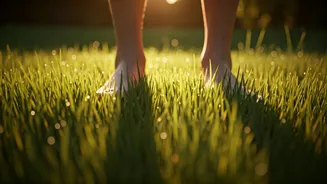
Walking barefoot on natural grass changes everything. The soft, uneven surface forces the small, intrinsic muscles in your feet to work harder to stabilize your body. This process enhances proprioception—your body's ability to sense its position in space. Better proprioception leads to improved balance and more efficient movement, which can reduce the load on your major joints. Grass provides natural cushioning, decreasing the ground reaction forces that jolt your body with every step on concrete. This isn't about mystical 'grounding'; it's simple biomechanics. By reconnecting your feet with the ground, you are essentially re-educating your nervous system and strengthening the very foundation of your posture and movement.
Simple Barefoot Drills to Start Today
Find a clean, safe patch of grass in a local park. Start slowly, for just 5-10 minutes at a time, to allow your feet to adapt. 1. **Mindful Walking:** Simply walk back and forth, paying close attention to how your foot lands. Try to land on your midfoot rather than heel-striking. Feel the grass beneath your feet. 2. **Toe Spreading:** Stand with your feet flat on the grass and try to spread your toes as wide as possible. Hold for a few seconds, then relax. Repeat 10 times. This helps activate dormant muscles. 3. **Short Foot Exercise:** Without curling your toes, try to shorten your foot by pulling the ball of your foot back towards your heel, lifting your arch. This is a powerful exercise for building arch strength. 4. **Single-Leg Balance:** Stand on one leg and try to hold your balance for 30 seconds. The uneven surface of the grass will make this more challenging and effective than doing it on a flat floor.
Safety First: What to Watch For
While the benefits are significant, transitioning to barefoot activity requires caution, especially for the urban dweller whose feet are unaccustomed to it. Always scan the area for sharp objects like glass, stones, or thorns before you begin. If you have pre-existing foot conditions, such as plantar fasciitis, or health issues like diabetes that affect sensation in your feet, it is crucial to speak with a doctor or physiotherapist before starting. The goal is to build strength, not to cause injury. Listen to your body. If you feel any sharp pain, stop immediately. Soreness in the muscles of your feet and calves is normal at first, but joint pain is a red flag.