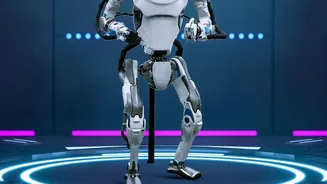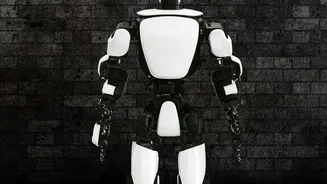






What was once science fiction is rapidly becoming factory fact. Human-shaped robots are stepping out of research labs and into the real world, with major firms in automotive and logistics beginning to test them for commercial use.
From Prototype to Production Line
For decades, humanoid
robots were staples of university demos and viral videos, showcasing impressive feats of balance and mobility but remaining far from practical application. That era is decisively ending. Companies like Figure AI, Apptronik, and Boston Dynamics are now partnering with industrial giants to deploy their machines in live production environments. These are not research experiments but commercial trials aimed at proving the robots can perform useful, economically viable work. The primary targets are tasks that are repetitive, physically demanding, or difficult to automate with traditional, fixed machinery.
The Humanoid Advantage
The key advantage of a human-shaped robot is its ability to operate in environments designed for people. Unlike conventional automation that often requires a factory to be built around it, humanoids can navigate existing aisles, use the same workstations, and potentially handle the same tools as human workers. This flexibility is a significant draw for 'brownfield' facilities—older factories and warehouses where redesigning entire production lines for fixed automation is prohibitively expensive. Companies like Apptronik, with its Apollo robot, and Tesla, with Optimus, are developing machines intended to perform a variety of tasks, from delivering parts to loading machines, offering a versatility that single-purpose robots lack.
Early Adopters in Automotive and Logistics
The automotive and logistics industries have emerged as the first major testing grounds. Automaker BMW, for instance, has a commercial agreement with Figure AI to use its robots for tasks in its Spartanburg, South Carolina plant. After a successful deployment where two 'Figure 02' robots contributed to the assembly of over 30,000 vehicles, the partnership has expanded to more complex logistics tasks with the newer 'Figure 03' model. Similarly, Mercedes-Benz is testing Apptronik's Apollo robot for delivering parts and kits to its assembly line. In the logistics sector, companies are exploring humanoids for sorting parcels and moving goods in distribution centers, tasks that currently rely heavily on manual labor.
The Hurdles to Widespread Adoption
Despite the rapid progress, significant challenges remain. One of the most critical is battery life; many current models can only operate for a few hours before needing a recharge, far short of a full work shift. Dexterous manipulation—the ability to reliably grasp and handle a wide variety of objects with the finesse of a human hand—is another major engineering hurdle. Safety is also a primary concern. Unlike caged industrial robots, humanoids are designed to work alongside people, requiring new standards and advanced sensing to prevent accidents. Finally, the economic case must be proven. For widespread adoption, these robots must demonstrate they can perform tasks reliably and at a cost that is competitive with both human labor and existing automation solutions.