



More Than Just the Longest Day
Every year around June 21st, the Northern Hemisphere enjoys its longest period of daylight. We welcome the official start of summer, plan late-evening outings, and complain about the heat. But the summer solstice isn't just a 24-hour event. It's a specific,
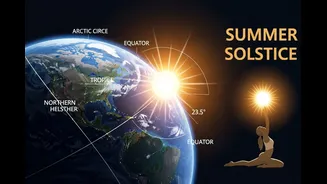
infinitesimally brief moment in time. While we experience the effects over an entire day, the solstice itself is an astronomical event that occurs in the blink of an eye. This is the point where our planet's axial tilt—the very reason we have seasons—reaches its maximum angle toward the Sun. Think of it like a pendulum reaching the highest point of its swing; for a split second, it pauses before changing direction. That pause is the solstice.
Defining the 'Geometric Instant'
So, what exactly is this “geometric instant” that has enthusiasts so captivated? It’s the precise moment when the Sun, from our perspective on Earth, appears to be at its northernmost point in the sky. At this instant, the North Pole is tilted most directly toward the Sun, at an angle of approximately 23.5 degrees. This is not an approximation; it is a calculable point in spacetime, tracked by observatories and space agencies down to the second. For 2024, this moment occurs on June 21. It’s the peak of the Sun's annual journey across our sky. After this instant, it begins its slow, imperceptible trek southward again, leading us eventually toward the winter solstice. The term 'solstice' itself comes from the Latin words 'sol' (sun) and 'sistere' (to stand still), reflecting this ancient observation that the sun appears to halt its northward climb.
Why Space Clubs Get Excited
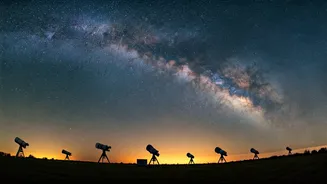
For amateur astronomers and members of India’s vibrant space clubs, the geometric instant is a celebration of celestial mechanics. It’s a chance to connect with the cosmos in a tangible way. While you can't 'see' the instant itself, you can observe its effects. At local noon on the solstice, for instance, an upright object will cast its shortest shadow of the entire year. This simple observation is a powerful, real-world demonstration of Earth's tilt and its orbit. Many astronomy clubs host 'zero shadow' events or workshops, particularly in locations near the Tropic of Cancer like Ujjain, where the sun is directly overhead at noon on the solstice. These events are a fantastic opportunity for public outreach, allowing people to witness a direct consequence of our planet’s celestial alignment. It’s a moment that validates scientific prediction and turns an abstract concept into a shared experience.
A Celebration of Precision and History
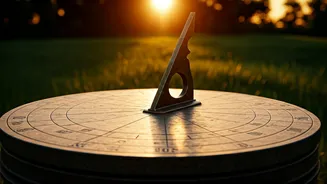
The buzz isn't just about shadows. For serious hobbyists, the solstice is a time for precision. They might use the event to calibrate homemade sundials, take precise measurements of the sun's altitude, or simply revel in the elegant predictability of the solar system. It’s a reminder that we live on a dynamic planet moving through space, governed by physical laws that we can understand and predict with incredible accuracy. Furthermore, celebrating the solstice connects modern sky-gazers to a tradition stretching back millennia. Ancient structures, from Stonehenge in England to the Jantar Mantar observatories in Delhi and Jaipur, were designed to align with the solstices and equinoxes. These were humanity's first astronomical computers. When a local space club gathers to watch the sunrise or measure a noon-time shadow, they are participating in a ritual of scientific curiosity that is as old as civilization itself. It’s a shared moment of wonder, linking the past with the present.