




What are eVTOLs, Anyway?
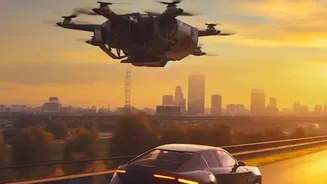
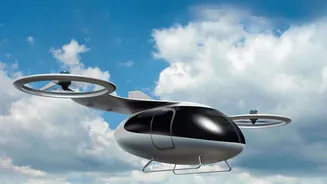
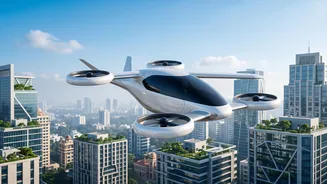
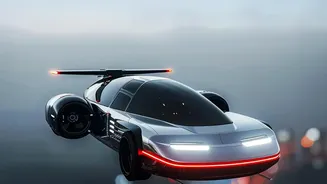
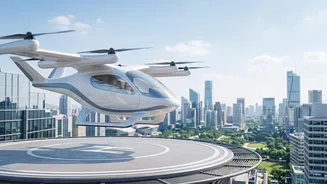
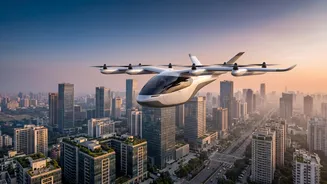
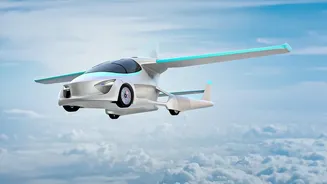
Imagine a vehicle that takes off and lands like a helicopter but flies like a plane, all powered by electricity. That’s an eVTOL in a nutshell. These aircraft use multiple rotors for vertical lift, eliminating the need for long runways, and then transition
to wing-borne flight for speed and efficiency. Unlike noisy, fuel-guzzling helicopters, eVTOLs are designed to be significantly quieter and produce zero emissions, making them ideal for navigating dense urban environments. They represent a new chapter in what the aviation industry calls Advanced Air Mobility (AAM), promising to turn hour-long road journeys into ten-minute flights. For instance, a trip from Delhi's Connaught Place to Gurugram, which can take up to 90 minutes by car, could be completed in about seven minutes.
The Race for India's Skies
Several key players are vying to pioneer this new form of transport. On the corporate front, InterGlobe Enterprises, the parent company of IndiGo, has partnered with US-based Archer Aviation. Their ambitious plan involves launching an all-electric air taxi service in India as early as 2026, with an agreement to potentially purchase up to 200 of Archer's 'Midnight' aircraft. Their initial focus is on high-traffic routes in Delhi, Mumbai, and Bengaluru.
Meanwhile, homegrown innovation is thriving. The ePlane Company, a startup incubated at IIT Madras, is a prominent domestic contender. It unveiled its first full-scale prototype, the e200X, in July 2026 and aims to begin certification flight tests in 2027. The company's initial focus is on creating air ambulance services before expanding to passenger taxis, with a target for commercial operations around 2028. Other startups like Bengaluru-based Sarla Aviation and Autosync Aviation are also entering the fray, developing their own aircraft and autonomous flight systems.
The Government's Guiding Hand
An entirely new mode of transport requires an entirely new rulebook. The Indian government, led by the Ministry of Civil Aviation and the Directorate General of Civil Aviation (DGCA), has been proactively building the necessary regulatory framework. Rather than waiting for the technology to arrive, the DGCA has already issued crucial guidelines for the design and certification of eVTOL aircraft and the authorisation of 'vertiports'—the landing and takeoff pads they will use. This framework addresses everything from airworthiness and pilot licensing to how these new aircraft will be integrated with existing air traffic management systems, using a parallel Unmanned Aircraft Traffic Management (UTM) system. This methodical approach is designed to ensure safety and provide clarity for companies investing in the sector.
More Than Just an Aircraft
Building an air taxi service isn't just about the flying vehicle; it requires a complete ecosystem. A major hurdle is infrastructure. Vertiports need to be strategically built into the urban landscape, on rooftops or at transit hubs, without disrupting city life. The DGCA and the Airports Authority of India (AAI) are developing the standards for these facilities, covering everything from load-bearing capacity to fire safety and airspace integration. Beyond the physical pads, this ecosystem includes high-speed charging networks, maintenance facilities, and a digital platform to manage the fleet and air traffic. The partnership between InterGlobe and Archer, for example, explicitly includes plans to jointly build vertiport infrastructure and train pilots and maintenance crews.
Challenges on the Horizon
Despite the momentum, significant challenges remain. Safety and public trust are paramount. The DGCA is aligning its certification standards with global benchmarks from the FAA and EASA to ensure the aircraft are rigorously tested for India's specific climate and high-density airspace. Another major factor is cost. While proponents claim fares will eventually be comparable to premium ground taxis, making the service accessible and commercially viable is a key test. Union Civil Aviation Minister Ram Mohan Naidu has emphasized that affordability will be just as important as safety, highlighting that local manufacturing could help lower costs. Finally, integrating a large number of low-flying aircraft over crowded cities requires a sophisticated air traffic management system that is still in development.