


What is the SHAPE Instrument?
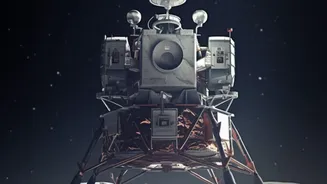
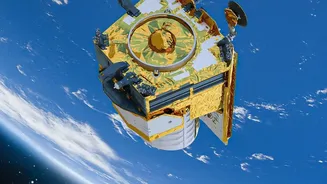
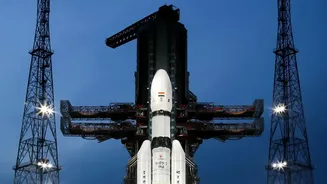
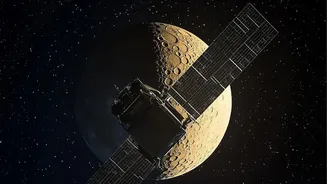
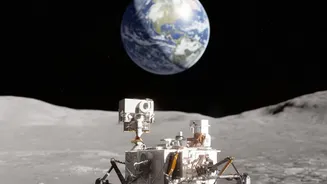
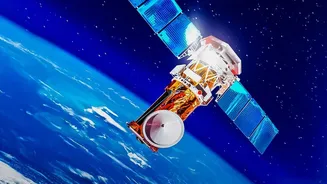
SHAPE stands for Spectro-polarimetry of HAbitable Planet Earth. It was the sole scientific instrument on the Propulsion Module of the Chandrayaan-3 spacecraft—the part of the mission that carried the Vikram lander and Pragyan rover to their lunar orbit.
While the lander and rover descended to the Moon's south pole, the Propulsion Module remained in orbit, with SHAPE turning its gaze back towards our home world. Conceived by scientists at ISRO's U. R. Rao Satellite Centre, SHAPE is a compact and lightweight instrument designed to do something quite remarkable: study Earth as if it were a distant, potentially habitable exoplanet. Its primary job is to analyze the light reflected from Earth in the near-infrared spectrum. By breaking down this light, it can hunt for specific signatures that might indicate a planet capable of supporting life.
A Unique Vantage Point From Lunar Orbit
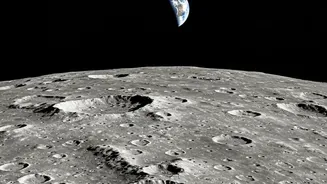
Why study Earth from the Moon? The perspective is invaluable. Satellites in Earth's orbit are too close to see the whole picture. From its perch in lunar orbit, SHAPE can observe the entire disc of the Earth as it rotates. This allows scientists to capture a 'disc-integrated' view, which is exactly the kind of signal we would receive from a planet orbiting a distant star. In essence, ISRO is using a known, life-bearing planet—our own—as a practice target. The goal is to perfect the techniques needed to identify biosignatures on faraway worlds. By studying how Earth's signature changes as it rotates, as clouds pass, and as different surfaces like oceans and continents come into view, researchers can build a reference library for future exoplanet-hunting missions.
The Science of Light and Life
SHAPE uses a technique called spectro-polarimetry. Spectroscopy involves breaking light down into its constituent colours, or wavelengths, to see what a planet's atmosphere and surface are made of. For example, certain gases absorb light at specific wavelengths, leaving tell-tale gaps in the spectrum. Polarimetry, on the other hand, measures the orientation of light waves. When light reflects off a surface, like clouds or oceans, its waves become polarized in a particular way. By combining these two measurements, SHAPE can gather rich data not just about the composition of Earth's atmosphere but also about the presence of features like clouds, which are crucial for a planet's climate and habitability. This method is designed to be a powerful tool for distinguishing a barren rock from a world with a dynamic atmosphere and potential signs of life.
Validating the Search for Other Earths
The initial findings from the SHAPE experiment have been about validation. The instrument has successfully operated from lunar orbit since August 2023, collecting data on Earth's spectro-polarimetric signatures. The primary success has been proving that the concept works. Scientists have demonstrated that they can retrieve reliable data about our planet's characteristics despite challenges like the spacecraft's orientation and instrumental noise. It has successfully measured the 'band polarization' associated with features in Earth's atmosphere, which is a crucial proof-of-concept. This confirms that a relatively small, lightweight instrument can indeed perform the complex measurements needed to characterize an Earth-like planet. This benchmark is vital, showing that future, more advanced telescopes can confidently use this technique in the search for extraterrestrial life.
A Stepping Stone for India's Space Ambitions
The SHAPE experiment is more than just a clever side mission; it represents a significant step forward for India's capabilities in planetary science and astrophysics. While the Vikram lander and Pragyan rover made headlines for their on-the-ground discoveries, SHAPE's long-term value lies in preparing ISRO for the next frontier of space exploration: the characterization of exoplanets. The data gathered serves as a crucial baseline for designing future space telescopes and instruments. By proving its ability to develop and operate such a sophisticated payload, India has solidified its position as a key player in the global quest to find another habitable world. The lessons learned from SHAPE will directly inform the next generation of missions aimed at answering one of humanity's biggest questions: are we alone in the universe?