





The Legend of the Hunter's Moon
First, what exactly is the Hunter's Moon? Traditionally, it is the full moon that follows the Harvest Moon. Its name comes from Native American folklore and was adopted by colonial Americans. October was the time when tribes would hunt to build up a store
of meat for the coming winter. After farmers had cleared their fields, it became easier for hunters to spot deer and other animals in the moonlight. The full Hunter's Moon for 2026 will reach its peak illumination on October 26. In India, this full moon corresponds with Sharad Purnima, a harvest festival that marks the end of the monsoon season.
Earth's Atmosphere: A Natural Color Filter
The reason the moon—or the sun, for that matter—changes color has everything to do with Earth's atmosphere. Think of the air around us not as empty space, but as a sea filled with countless invisible particles of gas, dust, and water vapor. When light from a celestial body travels through this sea of particles to reach our eyes, it doesn't arrive completely unchanged. The atmosphere acts like a giant filter, scattering some colors of light more than others.
The Science of Scattering Light
This filtering effect is known as Rayleigh scattering. Sunlight, which is what the moon reflects, is made up of a spectrum of colors, like a rainbow. At one end is blue and violet light, which has short, choppy wavelengths. At the other end is red and orange light, with long, stretched-out wavelengths. The tiny particles in our atmosphere are exceptionally good at scattering the short-wavelength blue light, bouncing it around in every direction. This is why our sky looks blue during the day. The longer, lazier wavelengths of red light are less affected and tend to pass straight through.
A Longer Journey Through the Air
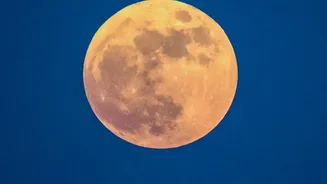
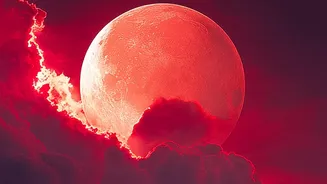
So, how does this apply to the moon? When the moon is high overhead, its light takes a relatively direct, short path through the atmosphere to your eyes. But when the moon is rising or setting, it is low on the horizon. From that angle, its light has to travel through a much thicker, denser slice of Earth's atmosphere. This extended journey means that even more of the blue and green light gets scattered away before it can reach you. With the blue light gone, the light that remains is dominated by the reds, oranges, and yellows, causing the moon to appear in these warm tones.
Why the Hunter's Moon Seems Special
While any full moon can look reddish when it's on the horizon, the effect can seem particularly dramatic with autumn moons like the Hunter's Moon. The moon's path across the sky in the fall often keeps it lower on the horizon for longer periods after moonrise, giving us a more extended view of this color-shifting effect. Additionally, autumn air can sometimes contain more dust or haze particles, which can further enhance the scattering of blue light and deepen the red appearance. The evocative name 'Hunter's Moon' simply makes us pay closer attention to this beautiful, recurring atmospheric phenomenon.
Not to Be Confused with a 'Blood Moon'
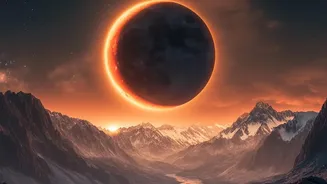
It's important to distinguish this atmospheric reddening from a 'Blood Moon,' a term popularly used to describe a total lunar eclipse. During a lunar eclipse, the Earth passes directly between the sun and moon, casting its shadow on the lunar surface. The moon turns red not because its light is traveling through the horizon atmosphere, but because the only sunlight reaching it is first filtered through the entirety of Earth's atmosphere from all sides. Earth's atmosphere essentially bends all of the planet's sunrises and sunsets onto the moon, bathing it in a coppery glow. So while both phenomena result in a red moon, their causes are entirely different.