



As winter approaches, Delhi is reintroducing stringent measures to combat air pollution. From November 1, 2026, new rules will restrict which vehicles can enter the capital, impacting lakhs of commuters from neighbouring NCR towns.
The Main Restriction: Who Is Affected?
The core of the new
rule is an entry ban on specific vehicles registered outside of Delhi. From November 1, 2026, until January 31, 2027, petrol and diesel vehicles that do not comply with Bharat Stage VI (BS-VI) emission norms will be barred from entering the national capital. This restriction applies to all non-BS-VI vehicles, including the widely used BS-III and BS-IV models, whether they are private cars or commercial vehicles. The move is part of Delhi's broader Winter Action Plan to prevent the city's air quality from deteriorating to 'Severe' or 'Severe+' levels. Estimates suggest this will impact over a million vehicles from NCR cities like Gurugram, Faridabad, Noida, and Ghaziabad that travel to Delhi regularly.
Checking Your Vehicle's Emission Standard
It is crucial for commuters to know their vehicle's emission standard. The Bharat Stage (BS) norm is typically mentioned on the vehicle’s Registration Certificate (RC). For those who need to verify it online, the government's VAHAN portal is the best resource. By visiting the Parivahan Sewa website and using the 'Know Your Vehicle Details' service, you can enter your vehicle's registration number. The resulting details will show the 'Emission Norms' field, which will specify if your vehicle is BS-III, BS-IV, or BS-VI compliant. BS-VI standards became mandatory for all new vehicles sold in India from April 1, 2020.
Which Vehicles Are Exempt From the Ban?
Several categories of vehicles are exempt from this entry restriction. The ban does not apply to any vehicle, regardless of its emission standard, that runs on cleaner fuels like Compressed Natural Gas (CNG) or is an Electric Vehicle (EV). Additionally, all vehicles engaged in essential and emergency services, such as ambulances, fire services, and those used for government-related work, will be permitted to enter Delhi. It's important to note that this specific ban targets vehicles registered outside Delhi; vehicles registered in Delhi are not subject to this entry restriction, though they must still comply with other existing pollution-related rules, such as the ban on overage vehicles and having a valid pollution certificate.
Penalties and Other Supporting Measures
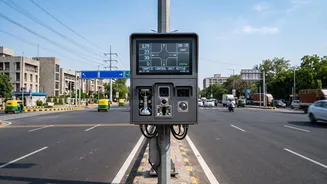
Violators of vehicle_related pollution norms face steep penalties. Driving a banned vehicle, such as a BS_III petrol or BS_IV diesel car during restricted periods, can attract a fine of ₹20,000 under the Motor Vehicles Act, 1988. To ensure compliance, enforcement will be strengthened at border checkpoints, with AI_powered Automatic Number Plate Recognition (ANPR) cameras helping to identify and flag non_compliant vehicles. Alongside the entry ban, other measures are being rolled out. This includes the 'No PUC, No Fuel' rule, where vehicles without a valid Pollution Under Control (PUC) certificate will be denied fuel at stations across the city. Furthermore, parking fees at authorised municipal lots will be doubled to discourage the use of private vehicles.
Why This Happens Every Winter
These stringent measures are part of the Graded Response Action Plan (GRAP), a set of emergency actions that are enforced in Delhi–NCR to combat air pollution, which peaks during the winter months. As temperatures drop, pollutants and particulate matter get trapped closer to the ground, leading to a sharp decline in air quality. Vehicular emissions are a major contributor to this pollution. The GRAP framework has four stages, which are activated based on the Air Quality Index (AQI). The ban on BS–III petrol and BS–IV diesel vehicles is typically enforced when the AQI enters the 'Severe' category (Stage III). By implementing these restrictions proactively, authorities aim to prevent the air quality from reaching hazardous levels and protect public health. The government is also encouraging residents to rely more on public transport, such as the Metro and electric buses, and to use carpooling to help reduce traffic and emissions.