





The Sun’s Noisy Outbursts
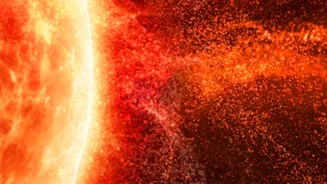
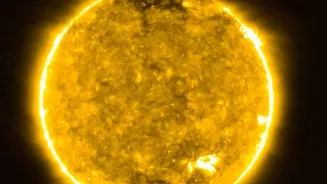
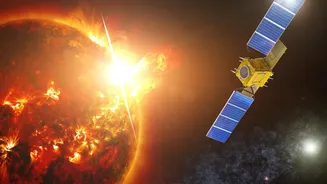
The Sun is not a quiet, unchanging ball of fire. It's a dynamic star with a powerful magnetic field that sometimes snaps and realigns, unleashing enormous amounts of energy. These events, known as solar flares, send radiation hurtling through space. Along
with light and X-rays, these flares can produce intense waves of radio energy called solar radio bursts. These bursts are essentially blasts of cosmic static. They travel at the speed of light, reaching Earth in just over eight minutes, and serve as the earliest warning sign of a potentially disruptive solar storm. These radio waves are the first clue that a flare has occurred and that more energetic particles might be on their way.
Listening to the Sun
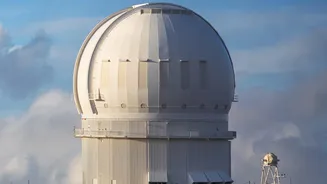
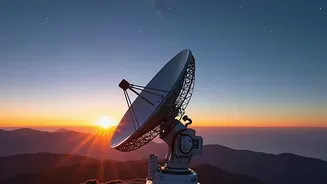
To detect these radio bursts, scientists can't just look at the Sun with a normal telescope. They use specialised ground-based radio observatories. These facilities use large arrays of antennas, forming a radio telescope, to listen to the specific frequencies emitted by the Sun. India plays a significant role in this global effort. The Gauribidanur Observatory near Bengaluru, operated by the Indian Institute of Astrophysics and Raman Research Institute, has been monitoring the Sun since 1976. Along with facilities like the Kodaikanal Solar Observatory, these sites provide continuous tracking of solar activity. These observatories create two-dimensional images of the Sun's corona using radio waves, allowing scientists to see the structure and origin of these energetic bursts.
Decoding the Solar Static
When a radio telescope detects a burst, scientists analyze its signature to understand the nature of the solar event. They classify bursts into different types (like Type II or Type III) based on how their frequency changes over time. A Type II burst, for example, drifts slowly from high to low frequencies. This tells scientists that a shock wave is moving out from the Sun, often pushed by a Coronal Mass Ejection (CME)—a massive eruption of solar plasma. By measuring this drift rate, they can estimate the speed of the shock wave. This information is crucial for predicting when the cloud of charged particles might arrive at Earth, which can take anywhere from hours to a few days.
From Burst to Blackout
The effects on Earth happen in two main stages. First, the intense X-rays and radio waves from the flare arrive almost instantly. The X-rays hit the sunlit side of Earth and energize the ionosphere, a layer of our upper atmosphere. This energized layer absorbs high-frequency (HF) radio signals, causing the radio blackouts that can disrupt long-distance communications for aviation and maritime operators. The solar radio bursts themselves can also act as direct noise, interfering with and degrading the weaker signals from Global Navigation Satellite System (GNSS) satellites, such as GPS and India's own NavIC system.
The Prediction Window
The initial radio burst acts as an advance warning. While the radio waves and blackouts they cause are immediate, the more damaging cloud of charged particles from a CME travels much slower. By observing the burst, scientists get a heads-up that a CME might be Earth-directed. This provides a critical window—from several hours to a few days—to prepare. Satellite operators can put their spacecraft into a safe mode, power grid managers can take precautions against surges, and airlines can reroute flights away from polar regions where the effects are strongest. This predictive capability is vital for mitigating the worst impacts of space weather on our infrastructure.
Shielding India's Digital Future
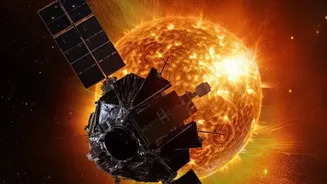
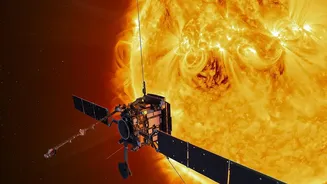
For a nation rapidly expanding its digital infrastructure, this science is more important than ever. India's reliance on satellite communication, the NavIC navigation system, online financial transactions, and modernised defence systems makes it vulnerable to space weather. Indian observatories in Gauribidanur and Kodaikanal, working alongside space missions like Aditya-L1, form a crucial line of defence. Their constant monitoring helps provide tailored space weather forecasts, protecting vital national assets and ensuring that the technologies powering modern India can withstand the Sun's occasional fury.