

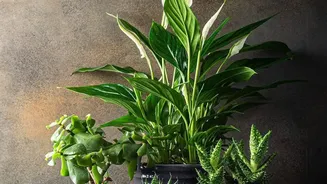
The Myth's Green Roots
The popular belief that houseplants can purify indoor air largely stems from a 1989 NASA study. Researchers were looking for ways to clean the air in sealed environments, like space stations. In small, sealed chambers, they found that certain common houseplants could
remove volatile organic compounds (VOCs) like benzene and formaldehyde from the air. This exciting finding was widely reported, and the idea of the “air-purifying plant” took root in the public imagination, creating lists of the “best” plants for the job that continue to circulate today.
A Question of Scale
The problem is that our homes are not small, sealed space stations. Subsequent research has shown that the air-purifying effect of plants in a typical home or office is practically negligible. The reason comes down to scale and airflow. A few potted plants simply cannot process airborne pollutants at a rate that competes with the constant air exchange happening in a building. Studies have calculated that you would need an impractically large number of plants—some estimate between 10 and 1,000 plants per square meter—to achieve the same air-cleaning effect as a building's standard ventilation system. That’s more like an indoor jungle than a living room.
What Actually Clears the Air
So if your pothos isn't doing the heavy lifting, what is? The answer is simple: ventilation. Exchanging stale indoor air with fresh outdoor air is the most effective way to dilute and remove pollutants. This can be achieved in several ways. The easiest method is opening windows and doors to create cross-ventilation. Using exhaust fans in kitchens and bathrooms is also crucial for removing moisture and contaminants at their source. Mechanical systems, like your home's HVAC system, also play a key role by circulating and filtering air. For targeted removal of airborne particles like dust, pollen, and smoke, a dedicated air purifier with a HEPA filter is far more effective than any plant.
The Real Benefits of Your Leafy Friends
To be clear, this doesn't mean you should get rid of your houseplants. They offer numerous proven benefits that have nothing to do with removing VOCs. The biggest benefits are psychological. Studies have shown that interacting with indoor plants can reduce stress, lower blood pressure, and improve mood. Tending to plants can be a mindful, grounding activity that provides a sense of accomplishment and connection to nature. They add beauty, color, and life to our indoor spaces, making them more pleasant and calming environments to live and work in. For these reasons alone, plants are a wonderful addition to any home.