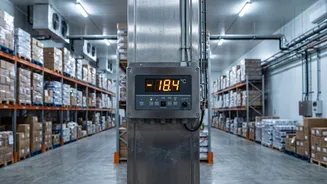



A Deliberate Thaw
In early November 2026, supermarket managers across Europe arrived at work to a costly surprise. In countries including Sweden, Belgium, Ireland, and Estonia, the refrigeration and freezer systems in dozens of stores had been remotely hijacked. Instead
of preserving food at sub-zero temperatures, the units were intentionally warmed up, in some cases to as high as 50°C. The attack forced stores to discard huge volumes of spoiled meat, dairy, and frozen goods, leading to significant financial losses and raising alarms about the security of the food supply chain. This followed a similar, widespread attack in France just weeks earlier, where hackers manipulated controllers from manufacturers like Danfoss, causing millions of euros in damages.
The Two Faces of Business Technology
To understand how this happened, it's crucial to distinguish between two types of technology in any modern business: IT and OT. Information Technology (IT) is what we typically think of as 'tech': laptops, servers, email systems, and corporate networks. Companies spend heavily to protect these with firewalls and antivirus software. Operational Technology (OT), on the other hand, is the hardware and software that controls physical processes. Think of factory machinery, power grid controls, and, in this case, the computerised systems that manage a supermarket's refrigeration. For decades, OT was siloed and secure simply because it wasn't connected to the internet. That has changed.
The Maintenance Gap
The European freezer attacks expose a critical failure in maintenance. Many of these OT systems, like refrigeration controllers, are now connected to the internet to allow for remote monitoring and repairs. However, they are often not maintained with the same diligence as IT systems. The French and other European incidents targeted controllers that were running on older, unsupported software for which security updates were no longer issued. According to official alerts from cybersecurity agencies like CISA in the U.S., attackers exploit these known weaknesses, which include failures to change default passwords, a lack of timely patching, and leaving the systems directly exposed to the internet. Hackers simply scanned the internet for these vulnerable, forgotten doorways and walked right in. The problem wasn't a lack of a sophisticated defence system, but a failure of basic digital upkeep.
A Lesson for Indian Industries
While these events unfolded in Europe, the implications are global and highly relevant for India. The Indian economy leans heavily on sectors rich in operational technology. This includes a massive food processing and agriculture sector reliant on cold storage chains, a booming pharmaceutical industry where temperature control is critical for medicine integrity, and a vast manufacturing base. As these industries embrace 'Industry 4.0' and connect more of their operational systems to the internet for efficiency, they also expose themselves to the same risks. An attack that cripples a cold chain for produce in Maharashtra or a vaccine storage facility in Hyderabad could have devastating economic and public health consequences. These European incidents are not a distant curiosity; they are a direct warning.