


A Glimpse into a Stellar 'Treasure Chest'
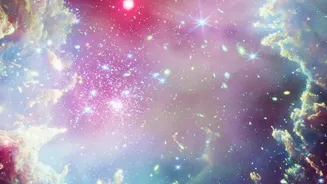
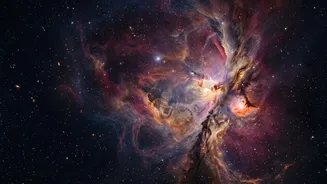
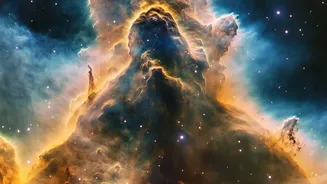
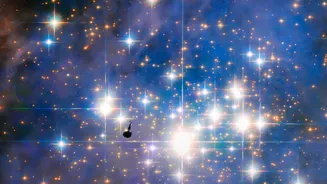
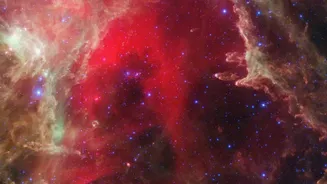
In a series of stunning images released this August, the JWST has focused its powerful instruments on a feature within the vast Carina Nebula, a sprawling star-forming region located about 7,500 light-years from Earth. Dubbed the 'Treasure Chest' by astronomers,
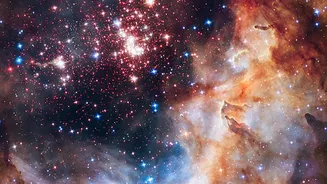
this area is a type of isolated gas and dust cloud known as a cometary globule. The images showcase a cluster of roughly 70 young, brilliant stars bursting forth from their dusty cocoons, with one star estimated to be 19 times more massive than our own sun. These views provide an unprecedented look into the chaotic and beautiful process of stellar birth, revealing details that were previously hidden from view.
The Power of Seeing in Infrared
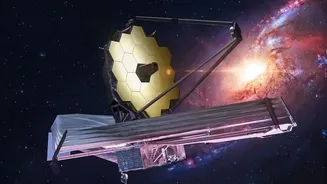
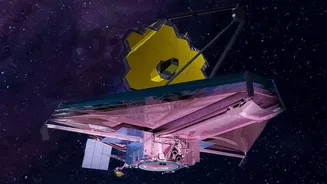
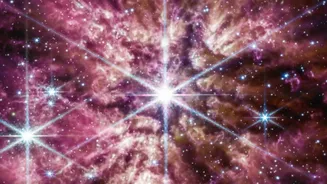
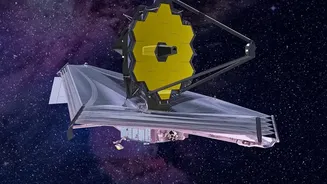
What makes these images so revolutionary is Webb's ability to see the universe in infrared light. Many of the most active stellar nurseries in our galaxy, including the Carina Nebula and another recently studied region, Sagittarius B2, are shrouded in thick clouds of cosmic gas and dust. To telescopes that see in visible light, like the Hubble Space Telescope, these regions appear dark and opaque. However, Webb's instruments are designed to detect the longer wavelengths of infrared light, which can penetrate these dense dust layers. This allows scientists to peer directly into the heart of these stellar cradles, witnessing the earliest and most rapid phases of star formation as they happen. The result is a vibrant portrait of galaxies in constant motion, with brilliant knots of newborn stars and glowing cavities carved by powerful stellar winds.
Deconstructing a Cosmic Cradle
These new images are more than just pretty pictures; they are rich datasets that help scientists deconstruct the entire process of star and planet formation. For example, in another young star system called FS Tau, Webb has revealed a protostar—a baby star still gathering mass—that is only a few million years old. The telescope's clarity shows energetic outflows and jets of material being shot out from the young star, which in turn slam into the surrounding gas and dust, creating glowing ridges and shaping the entire nebula. By studying the chemical composition of these clouds and the structure of these outflows, astronomers can trace the history of a star's activity and better understand how planetary systems, including our own, came to be.
A New Era of Astronomical Discovery
Each new image from the James Webb Space Telescope reinforces its role as a game-changing instrument for astronomy. It is not just about capturing one new star system; it is about building a comprehensive atlas of stellar evolution. By comparing dust-shrouded newborn stars with older, fully exposed clusters, scientists can connect the dots between star formation, stellar feedback, and even planet formation. The observations of regions like the 'Treasure Chest' are helping astronomers refine their estimates of star cluster ages and understand why star formation happens at different rates in different parts of the galaxy. These discoveries mark the dawn of a new astronomical era, where questions once thought unanswerable are now within reach.