

The Global Hunt for Asteroids
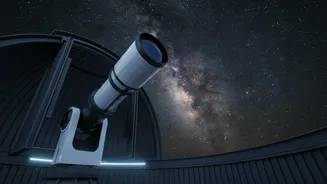
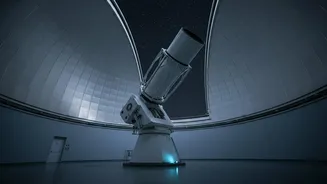
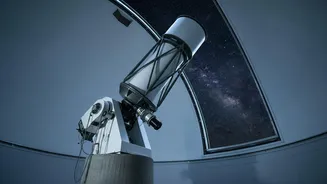
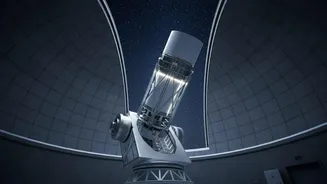
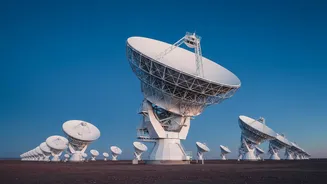
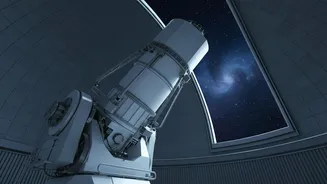
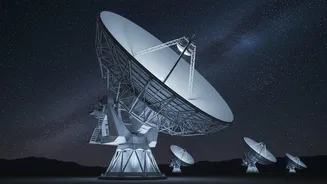
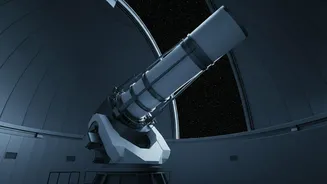
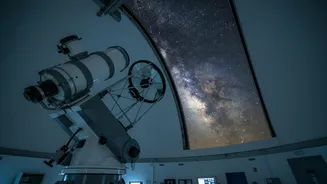
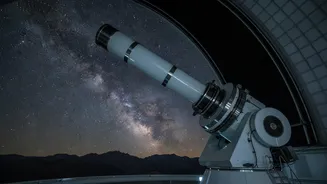
The first step in planetary defense is finding the asteroids. This is a monumental task handled by a network of survey telescopes around the world. Projects like the Catalina Sky Survey in Arizona and Pan-STARRS in Hawaii constantly scan the night sky.
They take multiple images of the same patch of sky minutes apart. Specialized software then searches for any 'star' that moves between frames. If a moving object is detected and isn't a known satellite or asteroid, it gets flagged as a candidate for a Near-Earth Object (NEO). This initial detection is just the beginning, kicking off a global game of celestial connect-the-dots.
Confirming a Celestial Suspect
Once a potential NEO is spotted, the information is sent to the Minor Planet Center (MPC), the international clearinghouse for all asteroid and comet observations. The MPC makes the data public so that other observatories—both professional and amateur—can perform follow-up observations. These additional sightings are crucial. Each new data point helps astronomers refine the object's path. With enough observations, a preliminary orbit can be calculated, confirming that it is indeed a new asteroid and plotting its course through the solar system. This collaborative effort ensures that no potential threat goes unexamined.
Predicting the Path Ahead
With a confirmed orbit, the real number-crunching begins. NASA's Center for Near-Earth Object Studies (CNEOS) and similar organizations worldwide use this data to model the asteroid's long-term trajectory. These aren't simple straight lines; the models must account for the gravitational pull of the Sun, all the planets, and even larger asteroids. However, an orbit is never known with perfect certainty. There's always a region of uncertainty, a 'cloud' of possible locations where the asteroid might be. The job of risk assessment is to see if any part of that cloud intersects with Earth's future position.
The Gravitational Keyhole Problem
Calculating future risk is complicated by something called a 'gravitational keyhole'. This is a very small, precise region of space near a planet, such as Earth. If an asteroid passes through one of these keyholes during a close approach, Earth's gravity could alter its orbit just enough to put it on a direct collision course for a future flyby. This makes long-term prediction incredibly complex. An asteroid might be projected to miss Earth safely in 2050, but if its path takes it through a keyhole, it could be nudged onto a return trajectory that poses a threat in 2080.
Automating Risk Assessment
To manage these complex calculations for thousands of NEOs, space agencies use automated systems. NASA's state-of-the-art system is called Sentry-II. It continuously monitors the catalog of known NEOs and calculates impact probabilities for the next century and beyond. Sentry-II is designed to be incredibly thorough, capable of finding even very low-probability impact scenarios that previous systems might have missed. It can assess risks with odds as low as a few chances in 10 million. These systems run constantly, updating risk files as new observations refine our understanding of each asteroid's orbit.
Communicating the Threat Level
Once a potential risk is identified, it needs to be communicated clearly. For this, scientists use two main scales. The Torino Scale is a simplified 0-to-10 rating designed for the public, where 0 means no hazard and 10 signifies a certain, catastrophic impact. Most new discoveries briefly get a 1 before being downgraded to 0 as more data confirms they are not a threat. For more technical discussions among scientists, the Palermo Scale is used. It provides a more detailed, logarithmic rating that compares the specific threat to the background risk of an impact from an object of a similar size.