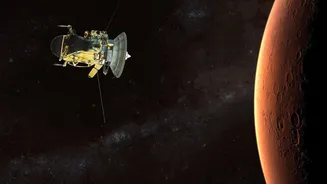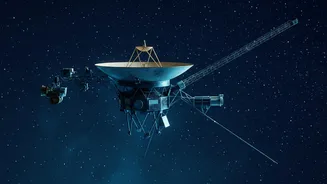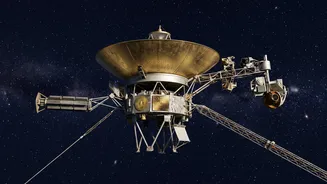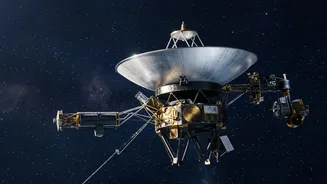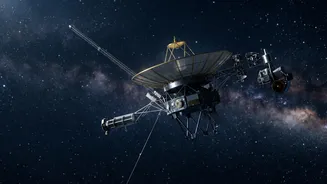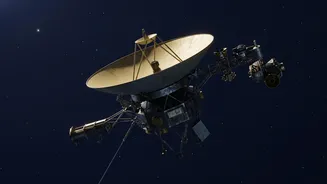



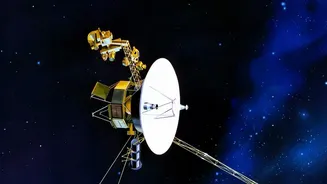
Humanity’s most distant emissary, Voyager 1, is talking to us again. After a nerve-wracking period of silence, NASA has restored contact, all while battling the craft’s other great challenge: a dwindling power supply nearly 50 years into its journey.
A Signal Gone Silent
For months, the stream of data from Voyager 1, currently over 25 billion kilometres away in interstellar space, was gibberish. The probe was still transmitting, but its messages were a nonsensical, repeating pattern of ones and zeroes. The culprit was a failure in the Flight Data Subsystem (FDS), one of the spacecraft's three onboard computers. The FDS is responsible for packaging data from the science instruments and the probe's own health checks before sending it to Earth. Without it, Voyager 1 was effectively muted, unable to tell the story of its journey through the void between stars.
The Long-Distance Repair Job
Fixing a computer is one thing. Fixing one that is so far away that a radio signal takes nearly 24 hours to reach it is another entirely. Any command sent by engineers at NASA's Jet Propulsion Laboratory (JPL) required a 48-hour wait for a response. After months of painstaking work, the team pinpointed the problem: a single faulty memory chip within the FDS was corrupting about three percent of its memory. The hardware could not be fixed, but the software could be rewritten. In a stunning display of remote engineering, the JPL team devised a clever workaround. They couldn't replace the broken section of memory, so they sliced up the affected code and meticulously redistributed it across other working parts of the FDS memory. The fix was a success, and in an unexpected turn, the spacecraft re-established contact on its own after a separate 48-hour blackout in October before the full fix could even be sent.
The 'Big Bang' Power-Saving Plan
Even as engineers celebrated the reconnection, the other existential threat to the mission loomed: power. Voyager 1 is powered by a radioisotope thermoelectric generator, which converts heat from decaying plutonium into electricity. After nearly five decades, that power source is fading, losing about four watts of power each year. To prolong the life of the remaining science instruments, NASA executed a plan nicknamed the 'Big Bang'. In September, engineers sent commands to simultaneously turn off three devices and substitute them with lower-power alternatives to keep the spacecraft warm enough to operate. This manoeuvre, previously tested on its twin Voyager 2, is expected to delay the need to shut down another science instrument, buying precious time for more discovery.
A Legacy Beyond Our Solar System
Every day that Voyager 1 continues to operate is a bonus for science. It remains the only human-made object to have entered interstellar space, the region between stars, which it did in 2012. Its instruments continue to measure the properties of plasma waves, magnetic fields, and cosmic rays beyond the protective bubble of our sun, known as the heliosphere. This data is invaluable, providing our only direct measurements of this unexplored frontier. While some instruments have been turned off to conserve power, the mission's longevity is a testament to its 1970s design and the ingenuity of the teams that have maintained it from afar. On November 18, 2026, the spacecraft will reach another milestone, becoming the first object to be one light-day away from Earth.