



The Fragile Nature of an Atmosphere
An atmosphere is a crucial ingredient for a habitable planet. It provides a shield from harmful radiation, traps heat to allow for liquid water, and contains the chemical building blocks for life. However, holding onto that gaseous blanket is a constant
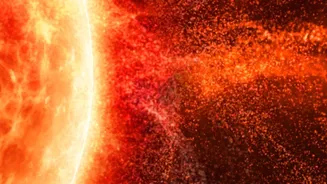
battle. A planet's own star can be its worst enemy. Many stars, particularly the common but volatile M-dwarfs, blast their nearby planets with intense X-ray and ultraviolet radiation. This high-energy onslaught can heat the upper atmosphere, causing gases to expand and escape into space over millions of years. This process, known as atmospheric escape or stripping, can turn a once-promising world into a barren, airless rock. A planet's size and gravity are also critical; smaller worlds have a harder time holding onto their air. Understanding this process is vital because it helps scientists refine where to look for life.
Webb's Unprecedented View
This is where the James Webb Space Telescope (JWST) has become an indispensable tool. Before JWST, detecting atmospheres around small, rocky planets was incredibly difficult, often leaving scientists with ambiguous results. The telescope's power lies in its sensitivity to infrared light and its use of a technique called transit spectroscopy. When an exoplanet passes in front of its host star from our perspective, a tiny fraction of the starlight filters through the planet’s atmosphere. The gases in that atmosphere absorb specific wavelengths of light, leaving a unique chemical signature. By analyzing this signature, astronomers can determine what gases are present, or, just as importantly, if there's any atmosphere at all. JWST is so sensitive it can measure the incredibly subtle dimming caused by these thin atmospheric layers, opening a new chapter in exoplanet science.
Case Studies in Planetary Survival
JWST is already delivering fascinating, and sometimes surprising, results. It has examined planets like 55 Cancri e, a super-hot, super-Earth so close to its star that its surface is likely a molten magma ocean. Scientists expected such a world to be a bare rock, its original atmosphere long gone. Yet, JWST found evidence of a secondary atmosphere, possibly rich in carbon dioxide or carbon monoxide, which may be continuously bubbling out from the magma ocean itself. In another landmark finding, astronomers detected an atmosphere around LHS 1140 b, a rocky super-Earth in its star's habitable zone. While helium was seen leaking from the planet, its presence confirmed an atmosphere exists, making it a prime candidate for further study into habitability. These findings show that even under extreme conditions, some planets can generate and sustain atmospheres in unexpected ways.
Redefining the 'Habitable Zone'
The classic definition of a 'habitable zone' is the region around a star where temperatures are just right for liquid water to exist on a planet's surface. However, JWST's research into atmospheric loss is showing that geography isn't everything. A planet can be in the perfect location, but if its star is too active or its gravity too weak, it will lose its water and air. For example, intense stellar flares from M-dwarf stars could strip away the atmospheres of even well-positioned planets. This research is forcing a re-evaluation of what makes a planet truly habitable. It’s not just about the planet's address, but also its individual resilience—its ability to withstand stellar radiation and retain a stable climate. The work of JWST is helping to narrow the search from simply finding planets in the habitable zone to finding planets that are actually habitable.