




A Planet's Two Clocks
To understand any planet's daily cycle, we need to look at two different 'clocks'. The first is its rotational period: the time it takes to spin once on its own axis. For Earth, this is roughly 24 hours, which we call a day. The second is its orbital
period: the time it takes to complete one full journey around the Sun. For us, that’s about 365 days, which we call a year. For Mercury, these numbers are far stranger and much closer together. The planet zips around the Sun in just 88 Earth days, meaning its year is less than three of our months. However, its rotation is incredibly sluggish. It takes a staggering 59 Earth days to complete just one spin. This huge difference from Earth is the first clue that something very unusual is happening with our solar system's smallest planet.
The Sun's Powerful Grip
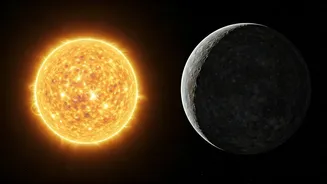
The main culprit behind Mercury's slow spin is the Sun itself. Because Mercury is so close to the Sun, it experiences an immense gravitational pull. This isn't just a gentle tug that keeps it in orbit; it's a powerful force that has shaped the very way the planet behaves. This force creates something called 'tidal torque'.
Think about how our Moon is 'tidally locked' to Earth—it rotates at the perfect speed so that we only ever see one side of it. The Sun has a similar, but even more complex, effect on Mercury. Over billions of years, the Sun's gravity has acted like a brake on Mercury's spin, slowing it down from what was likely a much faster rotation in its early history. But it didn't slow to a complete stop or a simple 1:1 lock like our Moon.
The Secret Is a Cosmic Rhythm
Instead of a simple lock, Mercury settled into a unique and stable rhythm with the Sun, known as a 'spin-orbit resonance'. The specific ratio for Mercury is 3:2. This is the secret to its 59-day rotation. What it means is this: for every two times Mercury completes its orbit around the Sun (two Mercurian years), it rotates on its axis exactly three times.
Let’s do the simple maths. Two of Mercury’s years are 2 x 88 = 176 Earth days. Three of Mercury’s rotations are 3 x 59 = 177 Earth days. The numbers are almost a perfect match. This isn’t a coincidence; it's a state of gravitational equilibrium. This 3:2 dance is the most energy-efficient and stable configuration for Mercury, given its proximity to the Sun and its specific orbital shape.
An Oval Orbit Makes It Possible
This strange 3:2 resonance wouldn't happen if Mercury had a perfectly circular orbit like Earth's. Mercury's path around the Sun is highly elliptical, or oval-shaped. This means there are times when it is much closer to the Sun (at its 'perihelion') and times when it is farther away.
The Sun's gravitational pull is strongest when Mercury is closest. This periodic 'tug' at the same point in its orbit, year after year, helped nudge and lock the planet’s rotation into this specific 3:2 rhythm. If its orbit were circular, the Sun's pull would be constant, and the planet would have likely become fully tidally locked, with one side perpetually facing the Sun. The oval orbit is the key that allows for this more complex and dynamic dance.
A 'Day' Longer Than a 'Year'
Here is where it gets truly mind-bending. While the planet rotates every 59 days (this is called a sidereal day), the experience of a 'day' on the surface is completely different. A 'solar day' is the time it takes for the Sun to return to the same position in the sky—for example, from one sunrise to the next. Because Mercury is moving so fast in its orbit while it is slowly rotating, one solar day on Mercury lasts for about 176 Earth days. Think about that: on Mercury, the time from one sunrise to the next is twice as long as its entire year! This means you could experience two full years on Mercury in the span of a single day-night cycle. It's a stark reminder of how wonderfully strange and diverse the worlds in our own solar system can be.