






A Cosmic Collision in Unprecedented Detail
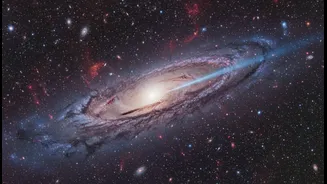
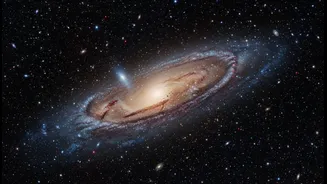
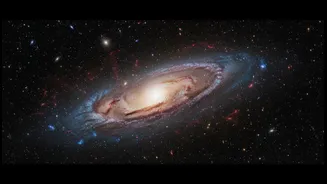
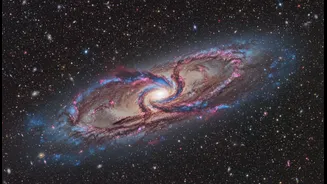
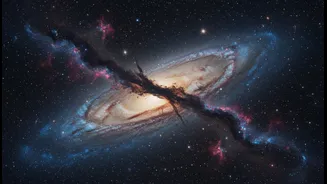
The James Webb Space Telescope (JWST) has released a stunning, high-definition image of Centaurus A, one of the most peculiar and well-studied galaxies in our cosmic neighbourhood. Located about 12 million light-years away, Centaurus A is the result of a colossal
merger between a giant elliptical galaxy and a smaller spiral galaxy roughly two billion years ago. This event left it with a distinctive, chaotic appearance, marked by a prominent band of dark dust obscuring its bright core. While previous telescopes like Hubble and Spitzer provided valuable data, their views were limited. Hubble's visible light couldn't pierce the dense dust, and Spitzer, while using infrared, lacked the resolution to see fine details. The new JWST image, combining its Near-Infrared (NIRCam) and Mid-Infrared (MIRI) instruments, cuts through that dust to reveal the galaxy's heart with astonishing clarity.
What the New Image Reveals
Webb's powerful infrared vision has uncovered a wealth of new information. For the first time, what appeared as a grainy glow is now resolved into millions of individual stars, allowing for a kind of 'galactic archaeology'. By studying these stars, astronomers can piece together the galaxy's history: when stars formed before the collision, during the merger, and in its aftermath. The image also highlights intricate dust structures, including a strange, parallelogram-shaped band and a mysterious 'S' shaped feature that puzzles scientists. These details provide crucial data about the raw materials for future star and planet formation. At the galaxy's core, an active supermassive black hole is feeding on surrounding material, launching powerful jets of energy that shape its environment. Webb's data shows how this black hole can both trigger and halt star formation, a key process in understanding how galaxies evolve.
The Indian Connection to Webb and the Cosmos
This global scientific endeavour has significant Indian connections. Several scientists of Indian origin have played key roles in the JWST mission itself. Hashima Hasan, who grew up in Lucknow and studied at the Tata Institute of Fundamental Research (TIFR), serves as the Deputy Project Scientist for the telescope, managing its science program. Kalyani Sukhatme, an IIT Mumbai alumna, was the project manager for the MIRI instrument, which was crucial for capturing the new Centaurus A image. Furthermore, Indian astronomers have a long history of studying cosmic phenomena like Centaurus A. The Ooty Radio Telescope in India was instrumental in measuring the properties of distant radio galaxies. More recently, Indian researchers have been using JWST data to make their own groundbreaking discoveries, such as identifying 'Alaknanda', one of the most distant spiral galaxies ever found. Scientists at institutions like TIFR and the Indian Institute of Science, Education and Research (IISER) are among select groups worldwide awarded observation time on the telescope, studying everything from star formation to the oldest galaxies.
Inspiring India's Future in Space
Discoveries like this do more than just rewrite textbooks; they ignite imaginations. For a nation with a proud and ambitious space program like India's, the achievements of the JWST are a powerful source of inspiration. The stunning visuals and profound scientific questions they raise can fuel interest in science, technology, engineering, and mathematics (STEM) among students across the country. Seeing Indian scientists at the forefront of such a monumental international project underscores the country's growing role in global scientific research. As Indian astrophysicist Jessy Jose, who uses JWST for her research, has noted, the public attention on Webb can inspire many youngsters to pursue a career in science. These images connect us to the grand scale of the universe and, in doing so, reinforce the importance of curiosity, collaboration, and the relentless pursuit of knowledge that drives ISRO and the entire Indian scientific community forward.