
A Mission of Unprecedented Complexity
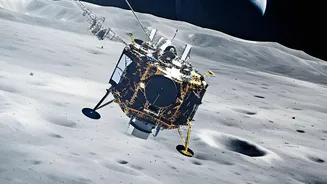
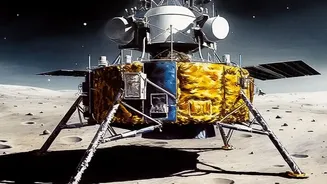
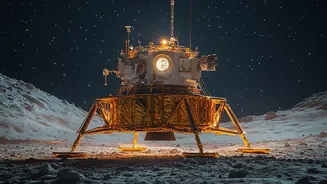
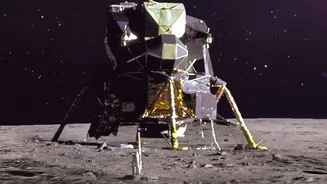
Chandrayaan-4 is not just another Moon mission; it's a quantum leap in India's space exploration capabilities. The goal is to land on the lunar surface, collect soil and rock samples, and return them to Earth for scientific study. If successful, India will
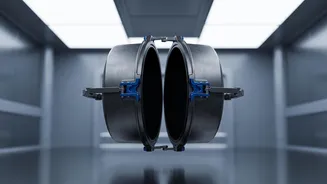
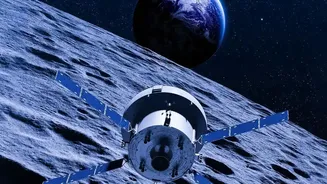
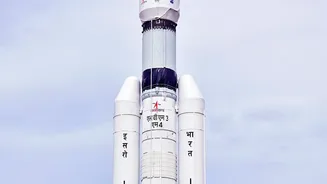
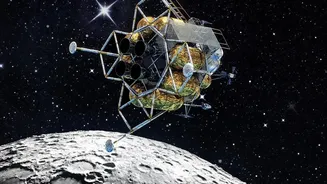
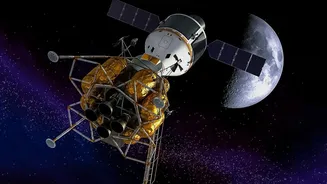
join an elite club of nations—the US, the former Soviet Union, and China—that have accomplished this feat. The mission is extraordinarily complex, involving five separate modules that will be launched on two of India's powerful LVM3 rockets. These modules include a Propulsion Module, a Descender Module (lander), an Ascender Module, a Transfer Module, and the crucial Re-entry Module that will carry the samples home. The entire assembly will be pieced together in Earth's orbit through automated docking procedures, a major first for ISRO, before it even begins its journey to the Moon.
The Fiery Return Journey
Getting to the Moon is a challenge ISRO has mastered. Bringing something back is another beast entirely. The most critical phase is the automated atmospheric re-entry. After collecting up to 3 kg of lunar material, the Ascender Module will lift off from the Moon, dock with the orbiting Transfer and Re-entry modules, and transfer the precious cargo. The Re-entry Module will then separate and begin its high-speed plunge towards Earth. This tiny capsule, holding priceless scientific data, will hit the top of our atmosphere travelling at speeds close to 28,000 kilometres per hour. At this velocity, the friction with air molecules will generate immense heat, creating a shroud of superheated plasma around the capsule. Managing this thermal load is the single biggest engineering challenge of the mission.
Mastering the 'Ballistic Re-entry'
To survive the inferno, the Re-entry Module relies on a combination of shape and material science. ISRO plans to use a 'ballistic re-entry' trajectory. The module has a blunt, rounded shape, a concept proven effective in human spaceflight programs like Gaganyaan. This design creates a powerful shockwave that pushes the most intense heat away from the capsule's surface. The module itself is shielded by a Thermal Protection System (TPS), a special ablative material designed to char and erode away, carrying the extreme heat with it and protecting the structure and the lunar samples inside. Entering the atmosphere is a delicate balance; if the angle is too steep, the capsule will burn up, but if it's too shallow, it could bounce off the atmosphere and be lost in space. The automated systems must navigate this narrow corridor with pinpoint precision.
From Space to Splashdown
The entire re-entry process, from atmospheric interface to landing, must be fully automated. After the module has shed most of its velocity through atmospheric braking, a sequence of parachutes will deploy to slow its final descent. ISRO has honed these technologies through previous experiments, including the Space Capsule Recovery Experiment (SRE-1) and tests for the Gaganyaan program, which validated parachute systems and recovery procedures. The final stage of Chandrayaan-4's journey will see the Re-entry Module splashing down in a designated zone, likely in the ocean, where recovery teams will be waiting to retrieve it. Preserving the samples in their pristine, uncontaminated state throughout this violent journey is of paramount importance.
Paving the Way for Future Ambitions
Chandrayaan-4 is far more than a scientific sample run. It is a crucial technology demonstrator for ISRO's future ambitions in space. Every complex maneuver—from automated docking in Earth orbit to launching from the Moon and surviving a high-speed re-entry—is a foundational capability required for sending Indian astronauts to the Moon by 2040. Success will not only provide Indian scientists with their first direct samples of lunar regolith but also build the operational confidence and technological expertise needed for future crewed missions, potential space stations, and even interplanetary sample returns.