


A Cosmic Sweet Spot
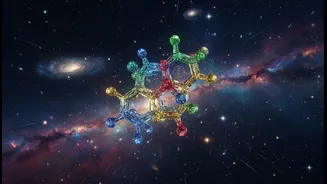
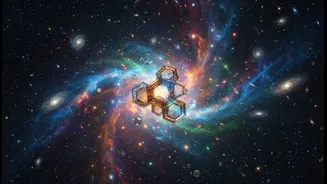
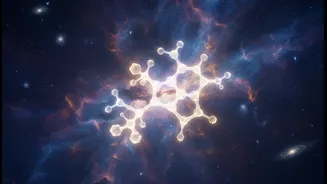
In a historic first, scientists have identified a true sugar molecule floating in the interstellar medium. The molecule, known as erythrulose, is a four-carbon sugar that on Earth can be found in things like raspberries. This discovery was made in a massive
cloud of gas and dust named G+0.693−0.027, located near the turbulent center of our own Milky Way galaxy, approximately 26,700 light-years from Earth. Using powerful radio telescopes in Spain, an international research team identified the distinct radio signature of erythrulose, matching the signals from space with laboratory data to confirm its presence. This isn't just any molecule; it's the first true sugar and one of the most complex non-cyclic molecules ever found in space, providing a tantalizing hint about the chemistry happening between the stars.
The Building Blocks Of What?
So, why the excitement over a pinch of sugar in the cosmos? Sugars are fundamental to life as we know it. They provide energy and form key components of RNA and DNA, the very blueprints of life. While erythrulose itself is not a component of our genetic material, it belongs to the same chemical family as ribose (in RNA) and could serve as a precursor for the chemical reactions that lead to life. The presence of such a complex molecule suggests that the processes that create life's building blocks may be widespread throughout the galaxy. Instead of life's ingredients needing to form on a young planet, this discovery supports the idea that they could be cooked up in deep space and delivered to nascent planets by comets and meteorites.
Challenging Old Theories
This discovery also challenges some long-held assumptions about how complex molecules form in space. The prevailing theory suggested that molecules grow sequentially, adding one carbon atom at a time. However, researchers found that erythrulose, a four-carbon sugar, was significantly more abundant in the cloud than any simpler three-carbon sugars. This unexpected finding suggests that erythrulose may form through a different pathway, perhaps by combining smaller, two-carbon molecules on the icy surfaces of cosmic dust grains. These icy grains, bombarded by cosmic rays and radiation, act as tiny chemical factories, assembling more complex structures than previously thought possible in the cold, harsh environment of space.
This Is Not a Discovery of Alien Life
It is crucial to be clear: finding sugar in space does not mean we have found aliens. Organic molecules, even complex ones, can be created by non-living geological and chemical processes. The discovery of erythrulose is not evidence of life itself, but rather evidence for the widespread availability of prebiotic chemistry—the chemical steps that precede life. It tells us that the raw materials for biology are not unique to our planet and could be readily available on countless other worlds across the galaxy. This shifts our perspective from asking whether the ingredients for life could have formed on early Earth, to recognizing that they were likely delivered from the cosmos.
The Next Frontier in Astrochemistry
Each new molecule identified in the interstellar medium adds another piece to the puzzle of our origins. The detection of erythrulose opens a new chapter in astrochemistry, pushing the boundaries of what we thought was possible. Scientists are hopeful that this breakthrough will lead to the detection of even more complex molecules, such as the five-carbon sugars like ribose that are essential for RNA. With powerful new tools like the James Webb Space Telescope continually revealing the chemistry of the cosmos in unprecedented detail, we are getting closer to understanding the chemical pathways that connect the stars to the emergence of life.