
Naked-Eye Sights: No Telescope Needed
You don’t need any special equipment to enjoy the grandest sights the night sky has to offer this month. The Moon and planets are putting on a spectacular show. Your main tools will be clear skies, a spot away from bright city lights, and knowing when
and where to look. Venus will be the unmissable 'Evening Star' all month, dazzling in the west just after sunset. Around mid-September, it reaches its peak brightness for the entire year, making it an exceptionally brilliant beacon.
The Famous Harvest Moon
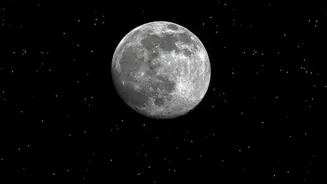
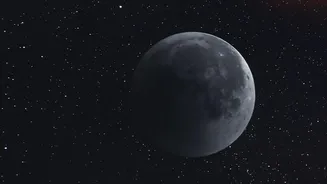
The main event this month is the Full Harvest Moon on the night of September 26. This is the full moon that falls closest to the autumnal equinox, which occurs on September 23. What makes it special is a unique orbital quirk: for several evenings around the 26th, the Moon will rise very close to sunset. This once provided farmers with extra hours of bright moonlight to bring in their crops. Look to the eastern horizon around sunset to see it appear as a huge, golden orb. As a bonus, the bright planet Saturn will be travelling nearby in the sky, making for a beautiful celestial pairing.
A Parade of Morning Planets
If you're an early riser, you'll be rewarded with views of Mars and Jupiter. Look towards the eastern sky in the hours before sunrise. The Moon acts as a helpful guide early in the month, passing close to Mars on September 6-7 and then Jupiter on September 8. These close approaches, or conjunctions, make it easy to identify which bright 'star' is actually a planet. While Mars will appear as a steady, reddish point of light, Jupiter will be noticeably brighter.
Through Binoculars or a Telescope
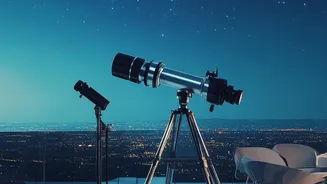
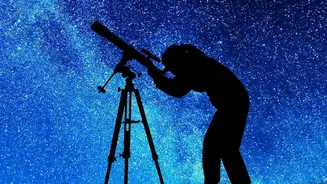
For those with a bit of optical aid, September offers the chance to hunt for some more elusive targets and see stunning details on our neighbours. Even a basic pair of binoculars will open up a new layer of the cosmos, revealing star clusters and faint objects invisible to the naked eye. The best nights for deep-sky viewing will be around the New Moon on September 11, when there is no moonlight to wash out the sky.
Challenge: Find a Distant Ice Giant
On September 26, the same night as the Full Moon, the distant planet Neptune will be at opposition. This means Earth is passing directly between Neptune and the Sun, placing the ice giant at its closest and brightest for the year. However, Neptune is so far away that it is never visible to the naked eye. You will need a telescope or a good pair of binoculars to spot it as a tiny, bluish, star-like point in the constellation Pisces. The glare from the Harvest Moon will make it a challenge, but a rewarding one for dedicated observers.
A Last Look at the Milky Way
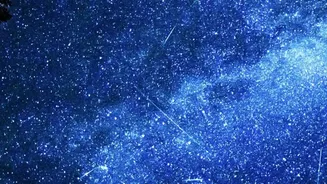
September is one of your last best chances in 2026 to see the magnificent core of our own Milky Way galaxy from the Northern Hemisphere. On the dark, moonless nights around September 11, find a location far from urban light pollution and look south. You'll see a luminous, hazy band of light stretching across the sky. This is the collective glow of billions of distant stars in the heart of our galaxy. Binoculars will reveal dense star fields and faint, fuzzy patches that are distant nebulae. It is a truly humbling and breathtaking sight before it sinks below the horizon for the winter.