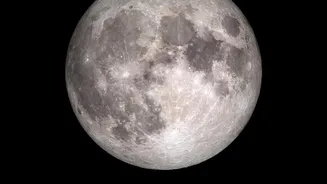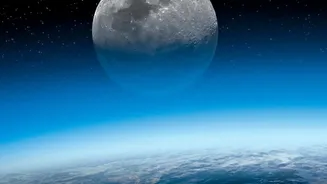








Ever seen a full moon hanging low on the horizon, looking so enormous you feel you could almost reach out and touch it? It’s a universal experience, but it’s also a powerful illusion. The secret lies not in the sky, but inside your own head.
The Magnificent Moon Illusion
It’s one of
the most reliable and breathtaking sights in nature: a full moon rising, glowing amber and appearing impossibly large as it crests distant hills or buildings. Yet, as that same moon climbs higher into the night sky, it seems to shrink, returning to its familiar, smaller self. This phenomenon is known as the Moon illusion. For thousands of years, thinkers from Aristotle to the present day have been captivated by it. The most fascinating part? The change in size isn't real. If you were to take a photograph of the horizon moon and another of the moon at its zenith with the same camera settings, they would be identical in size. In fact, due to the geometry of your position on Earth, the moon is technically slightly farther away when it’s on the horizon, meaning it should appear marginally smaller, not larger. This proves the illusion is entirely perceptual, a trick of the mind that reveals the complex and automatic ways our brains interpret the world.
A Lesson from a Pair of Tracks
To understand what's happening, we first need to look at a classic psychological puzzle: the Ponzo illusion. First demonstrated by Italian psychologist Mario Ponzo in 1911, the illusion is simple but powerful. Imagine two identical horizontal lines drawn across a pair of converging lines, like railway tracks disappearing into the distance. The top line, placed where the tracks are closer together, will invariably appear longer than the bottom line. Your rational mind knows they are the same length—you could measure them to be sure—but your visual system refuses to see it that way. This isn't a flaw in your vision. Instead, it’s a side effect of a highly useful cognitive mechanism. Your brain interprets the converging lines as a cue for depth and distance. Because it assumes you're looking at a 3D scene, it applies a rule: if two objects cast the same-sized image on your retina, but one appears to be farther away, the 'farther' object must be physically larger.
Connecting the Earth to the Sky
The leading explanation for the Moon illusion is that it's a large-scale version of the Ponzo illusion. The 'converging lines' aren't railway tracks, but the texture of the landscape itself—trees, buildings, clouds, and the ground stretching out to the horizon. When the moon is low in the sky, it is surrounded by these depth cues. Your brain sees the moon sitting 'on' or 'behind' these distant objects and perceives it as being very far away. Later, when the moon is high overhead, it floats in a vast, empty expanse of sky with no reference points. Without any cues to suggest great distance, your brain perceives the zenith moon as being closer. In both positions, the moon projects the same size image onto your retina. But just as with the Ponzo illusion, your brain adjusts its perception based on the presumed distance. The 'far away' horizon moon is perceived as being huge, while the 'closer' zenith moon is perceived as being smaller.
The Brain's Clever Shortcut: Size Constancy
This automatic correction process is known as size constancy. It’s a fundamental cognitive mechanism that allows us to perceive objects as maintaining a stable size regardless of their distance from us. It’s why a person walking away from you doesn’t appear to physically shrink, even though the image they project onto your retina gets progressively smaller. Your brain automatically scales their perceived size up to account for their increasing distance. The Moon illusion happens because our brains apply this same Earth-bound logic to a celestial object. We are so accustomed to seeing things on the horizon as being far away that we can't help but apply that rule to the moon. Our visual system is not built to intuitively understand that the moon's distance from us is immense and relatively fixed, regardless of its position in our sky. It takes the available data—the retinal image and the environmental cues—and makes its best guess, resulting in a spectacular perceptual error.
A Beautiful, Persistent Mystery
While the apparent distance hypothesis, explained by the Ponzo illusion, is the most widely accepted theory, it's worth noting that no single explanation has been universally agreed upon by all scientists. Some researchers point to other factors, such as the way our eyes focus on near versus far objects. But the link between the landscape's depth cues and our brain's size-scaling mechanism remains the most compelling piece of the puzzle. It beautifully illustrates that perception is not a passive act of seeing, but an active process of construction. The next time you see that giant, golden moon on the horizon, take a moment to appreciate the illusion. It’s a stunning reminder of the powerful, invisible cognitive machinery that constantly works to make sense of our world, even if it gets things wonderfully wrong sometimes.