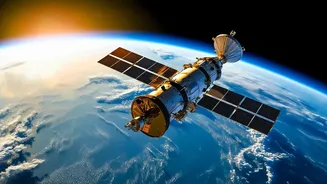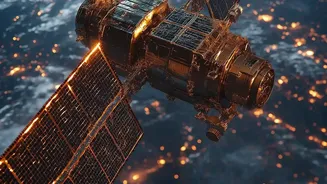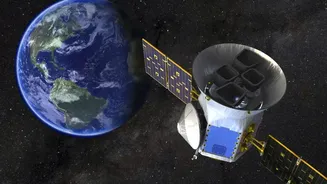



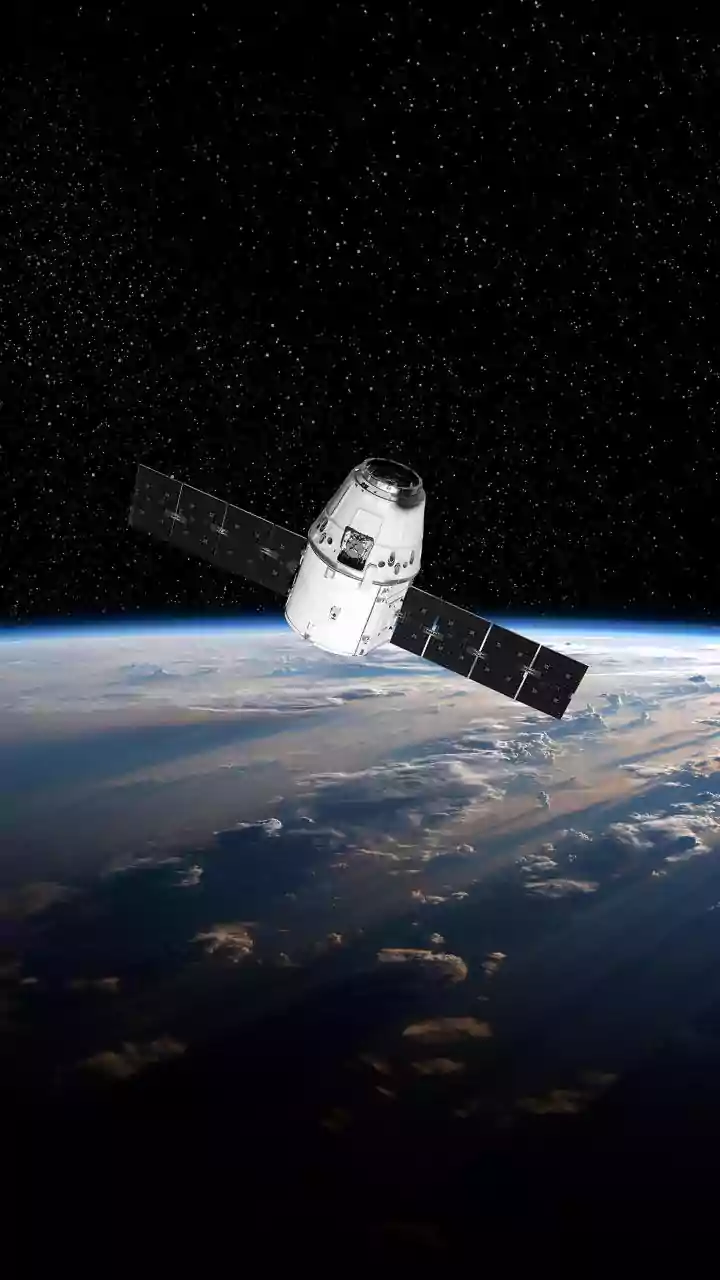


The dream of a clear night sky, filled with the faint light of distant galaxies, is facing a new and powerful challenge. It’s not just more communication satellites, but a plan to launch thousands of orbital data centers into low Earth orbit.
What is Orbital Computing?
Imagine a data
center, with its rows of powerful servers processing information, but instead of being in a massive building on Earth, it's a network of satellites circling the planet. This is the core idea behind orbital computing. Companies like SpaceX, Google, and a growing list of startups are investing heavily in this new frontier. The goal is to move data processing into space, closer to where much of the data is now collected by Earth-observation and other satellites. This reduces the time and bandwidth needed to send vast amounts of raw data back to the ground, allowing for faster analysis of everything from climate patterns to agricultural yields. These orbital data centers are designed to handle complex workloads, including AI computations, scientific simulations, and secure data storage, powered by near-constant sunlight.
An Increasingly Crowded Sky
The scale of this planned expansion is staggering. While today there are just over 11,000 active satellites, proposed projects could increase that number dramatically. SpaceX alone has filed for permission to launch up to a million satellites for its orbital data center ambitions, a project that would be supported by its next-generation Starship rocket. Other companies like Starcloud have filed for tens of thousands of their own. These new 'mega-constellations' would be far more numerous than existing internet satellite networks like Starlink. The goal is to create a powerful, interconnected mesh of computing nodes in low Earth orbit. While proponents see a future of unparalleled computing power, astronomers see a sky so crowded it could fundamentally alter their ability to view the cosmos.
The Astronomer's Dilemma
For astronomers, the problem is twofold: light pollution and radio interference. Ground-based telescopes require long exposures to capture the faint light from distant stars and galaxies. When a satellite passes through the telescope's field of view, its sunlit surface creates a bright streak across the image, potentially ruining hours of observation. Losing even a few of these exposures can degrade the quality of the final data, making it harder to study everything from near-Earth asteroids to the evolution of the universe. The issue is most pronounced during twilight hours, a critical time for many surveys. The International Astronomical Union (IAU) has expressed deep concern, noting that the industrial use of low Earth orbit poses a major threat to science.
More Than Just Pretty Pictures
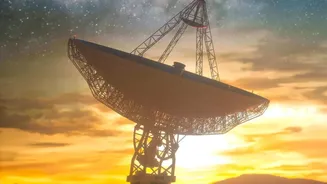
The interference goes beyond just optical light. Every satellite uses radio waves to communicate, and these signals can be millions of times stronger than the faint cosmic radio waves that astronomers study. This radio frequency interference (RFI) can completely swamp the signals from black holes, forming stars, and distant galaxies, effectively blinding radio telescopes. Worse, it's not just the intended communication signals that cause problems. Unintended electromagnetic radiation leaking from the satellites' onboard electronics can also create a persistent 'noise' that makes it harder to detect faint astronomical objects. As thousands of new satellites are launched, a sky that was once 'radio quiet' is becoming increasingly loud, threatening to obscure our window into the universe.
A Search for Solutions
The conflict has spurred a search for compromises. Astronomers and industry groups are working on mitigation strategies. For optical interference, solutions include designing satellites with less reflective surfaces, orienting solar panels to avoid reflecting sunlight back to Earth, and keeping satellites in lower orbits so they enter Earth's shadow sooner after sunset. Software is also being developed to help observatories predict when and where satellites will pass, allowing telescopes to briefly close a shutter to 'blink' and avoid the streak. For radio interference, improved shielding on satellites and better data-processing algorithms can help filter out some of the noise. However, organizations like the IAU argue that without thoughtful regulation and collaboration, these mitigation efforts may not be enough to protect the dark and quiet skies essential for discovery.