


A New Eye on the Cosmos
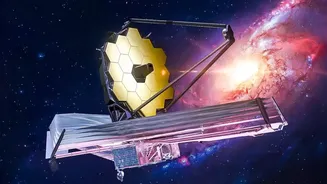
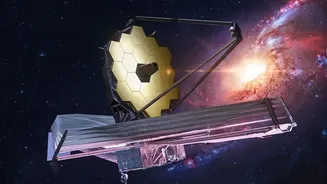
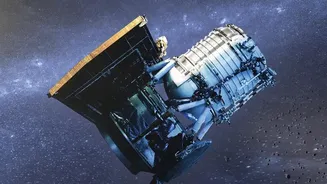
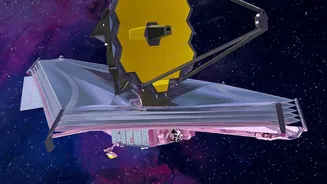
Launched in late 2021, the James Webb Space Telescope is the successor to the Hubble Space Telescope, but it sees the universe in a fundamentally different way. While Hubble primarily observes visible and ultraviolet light, JWST is optimized to see in infrared.
This is a crucial distinction. Infrared light is essentially heat radiation, allowing the telescope to peer through cosmic dust clouds that obscure the vision of other observatories and to see objects that are too cool to glow in visible light. Its massive 6.5-meter primary mirror, over six times larger in area than Hubble's, allows it to collect faint infrared signals from the most distant reaches of the universe with unprecedented clarity. This combination of a huge mirror and infrared focus is precisely what makes it a revolutionary tool for studying exoplanets—planets orbiting stars other than our Sun.
The Science of Starlight and Shadows
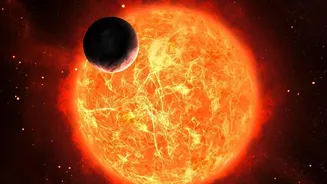
The primary method JWST uses is called transmission spectroscopy. Imagine an exoplanet passing directly in front of its host star from our point of view—an event called a 'transit'. As the planet crosses, a tiny fraction of the starlight filters through the planet's atmosphere before continuing its journey to the telescope. The molecules within that atmosphere absorb very specific colours, or wavelengths, of light. JWST’s highly sensitive spectrographs act like a prism, splitting the starlight into its full rainbow of colours. By comparing the light spectrum before and during the transit, scientists can see which colours are missing. Those missing slivers of light are the chemical fingerprints of the gases in the planet's atmosphere.
Water's Unmistakable Signature
This is where JWST’s infrared advantage becomes undeniable proof. Different molecules absorb different wavelengths, but water (H2O) has a particularly strong and unambiguous absorption signature in the infrared portion of the spectrum. Think of it as a unique barcode. While other telescopes, including Hubble, could hint at the presence of water, their observations were often muddled or lacked the resolution to be certain. JWST, however, is tuned to see this specific barcode with extreme precision. When its instruments detect a significant dip in light at the exact wavelengths known to be absorbed by water, it provides clear, irrefutable evidence that water vapour is present in that alien atmosphere. This level of certainty was simply not possible before.
From Theory to Tangible Discovery
This technique is not just theoretical; it has already yielded groundbreaking results. One of the telescope’s early targets, the gas giant WASP-96 b, produced a spectrum showing the definitive signature of water. More recently, observations of planets like WASP-107b have revealed not only water but also sand-like silicate clouds and sulfur dioxide, painting a complex chemical picture of its atmosphere. Another key discovery involved K2-18 b, a 'Hycean' world candidate, where JWST detected carbon-bearing molecules like methane and carbon dioxide alongside signs of water, a tantalizing mix for astrobiologists. In each case, the infrared readings provided a level of detail that transforms these distant worlds from simple points of light into places with distinct weather and chemistry.
Beyond Water: The Search for Habitability
While finding water is a monumental step, it is just one piece of the puzzle in the search for life. JWST’s ability to detect a whole suite of molecules is what makes it so powerful. Scientists are looking for a cocktail of chemicals that might indicate a working ecosystem. For example, detecting water alongside methane and carbon dioxide, while noting an absence of ammonia, could point toward biological processes similar to those on Earth. The telescope’s instruments are sensitive enough to probe the atmospheres of smaller, rocky planets similar in size to our own, like those in the TRAPPIST-1 system. By analyzing the precise mix of gases, researchers can begin to assess whether a planet has the right ingredients not just for water, but for a potentially habitable environment.