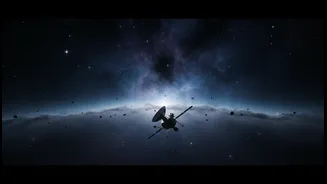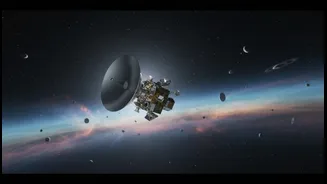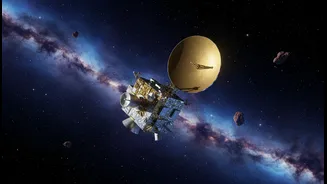






A Pioneer Awakens from a Long Nap
On July 7, 2026, NASA confirmed its New Horizons spacecraft resumed full operations after a 321-day hibernation, its longest to date. Launched in 2006, this incredible probe is famous for conducting the first-ever flyby of Pluto in 2015 and later visiting
Arrokoth, the most distant object ever explored up close, in 2019. To conserve power and protect its systems during the long cruise through space, mission controllers at the Johns Hopkins Applied Physics Laboratory (APL) periodically put the spacecraft into a low-power hibernation mode. Now, at a staggering 9.5 billion kilometres from Earth, it has received its wake-up call and is ready for the next phase of its historic journey. Even at the speed of light, the confirmation signal took nearly nine hours to reach Earth.
Journey to the Solar System's 'Third Zone'
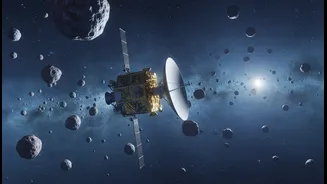
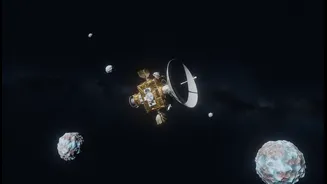
New Horizons is currently travelling through the Kuiper Belt, a massive, doughnut-shaped region beyond the orbit of Neptune that scientists call the solar system's "third zone". Unlike the rocky asteroid belt between Mars and Jupiter, the Kuiper Belt is populated by countless icy bodies, remnants from the dawn of our solar system over 4.5 billion years ago. These objects are considered cosmic fossils, preserved in a deep freeze and holding vital clues about how planets like Earth were formed. Exploring this region is a primary goal for the mission's current phase, offering a unique window into our planetary origins that is impossible to get from Earth.
What Clues Is New Horizons Hunting For?
While another close flyby of a specific object like Arrokoth isn't planned, the mission is far from over. As an observatory in the outer solar system, New Horizons is in a unique position. Some of its instruments remained active even during hibernation, continuously measuring the solar wind, dust particles, and plasma environment. Now fully awake, it will begin transmitting all that stored data. In the coming weeks, its powerful spectrograph will study the distribution of hydrogen at the solar system's edge, helping scientists understand the boundary between our sun's influence and interstellar space. These observations provide a continuous stream of data from a region no other active spacecraft is exploring.
An Ever-Expanding Frontier
The data from New Horizons has already challenged our understanding of the solar system. Recent findings from its dust counter suggest the Kuiper Belt might be much larger than previously thought, potentially extending much farther out than models predicted. This hints at a whole new population of objects colliding and producing dust in the distant darkness. Every observation could lead to a new discovery, refining our maps of our own cosmic neighbourhood. This extended mission isn't just about looking at specific objects; it's about characterising the environment of the outer solar system itself, providing ground truth for our theories.