
Reading Shadows and Starlight
The fundamental challenge in studying exoplanets is their immense distance and the overwhelming glare of their parent stars. Most are too far and too faint to be seen directly. So, astronomers become detectives, looking for tiny, tell-tale clues in starlight.
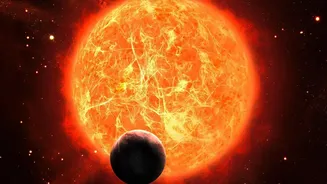
The most powerful technique is called the transit method. When a planet passes in front of its star from our perspective, it causes a minuscule dip in the star's brightness. By observing these transits, scientists can determine a planet's size and orbit. But the real magic happens when they analyse the starlight that has been filtered through the planet's atmosphere during that transit.
Decoding the Atmosphere's Barcode
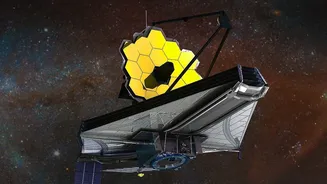
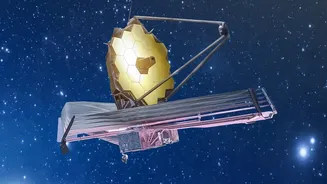
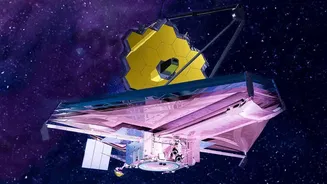
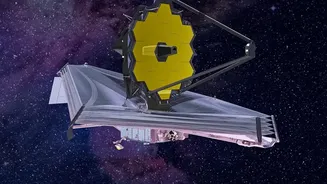
The key to understanding an exoplanet's air is a method called spectroscopy. Think of passing light through a prism to create a rainbow; spectroscopy does something similar but in much greater detail. When starlight passes through a planet’s atmosphere, different chemical elements and molecules absorb light at specific, unique wavelengths. This creates a pattern of dark lines in the star's light spectrum, like a chemical barcode. By reading this barcode, astronomers can identify gases like water vapour, methane, or carbon monoxide. Powerful instruments on telescopes like the James Webb Space Telescope (JWST) excel at this, peering into the infrared spectrum where many of these molecular fingerprints are found.
Mapping Supersonic Winds
Identifying gases is one thing, but how do you measure wind speed from light-years away? This is where high-resolution spectroscopy and a principle called the Doppler effect come in. The Doppler effect is the same phenomenon that makes an ambulance siren change pitch as it moves towards you and then away. When winds in an exoplanet's atmosphere are moving towards Earth, they slightly compress the light waves, shifting the atmospheric barcode towards the blue end of the spectrum (a blueshift). When they move away, the light is stretched, causing a redshift. The size of this shift allows astronomers to calculate the wind's velocity with astonishing precision.
A Universe of Wild Weather
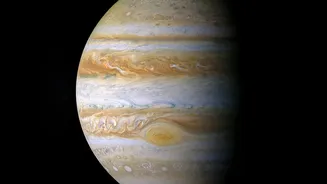
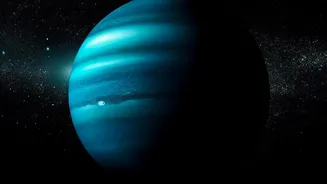
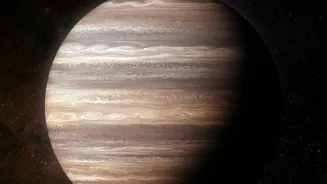
Using these techniques, scientists have uncovered truly extreme weather. On the exoplanet HD 189733b, they measured winds screaming from the hot day-side to the cooler night-side at over 8,700 km/h—more than twenty times faster than the strongest winds ever recorded on Earth. More recently, on a 'puffy' gas giant named WASP-127b, located over 500 light-years away, astronomers clocked an equatorial jet stream moving at a staggering 33,000 km/h. These are supersonic winds, faster than the speed of sound on those worlds. By measuring Doppler shifts as the planet enters and exits its transit, scientists can even create a basic weather map, distinguishing the wind speeds on opposite sides of the planet.