



Creating a Digital Universe
At its core, an astronomical computer model is a program built on the laws of physics. Scientists encode rules for gravity, gas dynamics, radiation, and even the mysterious physics of dark matter into numerical algorithms. By setting initial conditions—like
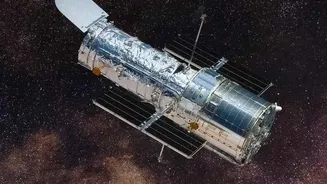
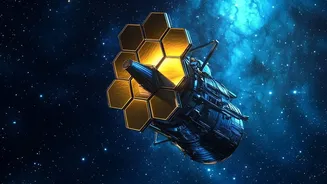
the state of the universe shortly after the Big Bang—they can run simulations that evolve these digital universes over billions of years. This allows them to create virtual galaxy clusters and cosmic structures to study phenomena that are impossible to recreate in a lab. For example, a model can simulate how a massive galaxy cluster's gravity bends the light from a more distant galaxy, an effect known as gravitational lensing. By comparing these simulated lenses to real images from telescopes like the Hubble, astronomers can weigh the galaxy cluster and map the invisible dark matter within it.
Training AI to Find the Hidden
Simulations are also crucial for training artificial intelligence. Before an AI can find a rare object, it needs to know what to look for. Researchers train neural networks—a form of AI inspired by the human brain—by showing them hundreds of thousands of simulated images. For instance, to find gravitational lenses, an AI is fed countless simulated examples of how lenses distort background light into arcs and rings. After this training, the AI can analyze real telescope images and spot new potential lenses with incredible speed and accuracy. This method turns a process that once took experts weeks or months into a task that can be completed in seconds, revolutionizing the search for these cosmic magnifying glasses.
Taming the Data Deluge
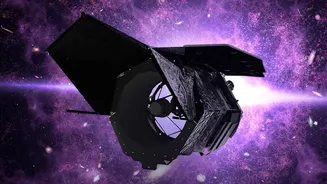
Modern astronomy is facing a data explosion. Telescopes like the Vera C. Rubin Observatory, which began operations in 2025, can produce about 20 terabytes of image data every single night. It is humanly impossible to sift through this much information manually. The Rubin Observatory is expected to generate up to 10 million alerts each night, flagging changes in the sky like supernovae or moving asteroids. This is where machine learning becomes essential. AI algorithms are designed to automate the classification of these alerts, separating interesting transient events from instrument noise or known variable stars. This allows astronomers to focus their attention on the most promising and scientifically valuable discoveries hidden within the flood of data.
Finding New Worlds and Cosmic Anomalies
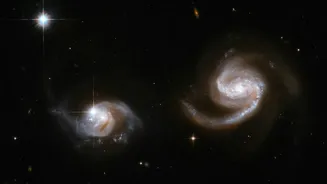
The search for exoplanets—planets orbiting other stars—has been supercharged by machine learning. AI algorithms are trained to detect the tell-tale dip in a star's brightness that occurs when a planet passes in front of it, a method called transit detection. These models can distinguish the faint signal of a planet from other stellar variations or instrument errors, leading to the discovery of new worlds that might have been missed by human analysts. In one recent project, an AI tool named AnomalyMatch was used to sift through nearly 100 million image cutouts from the Hubble Legacy Archive. In just two and a half days, it identified nearly 1,400 anomalous objects, including colliding galaxies and other rare phenomena, over 800 of which had never been documented before. This demonstrates how AI can not only find what we are looking for, but also uncover completely unexpected cosmic oddities.