




A Cosmic Shower of Ice
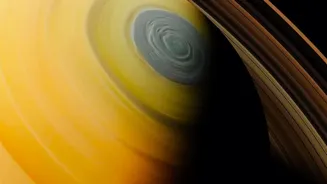
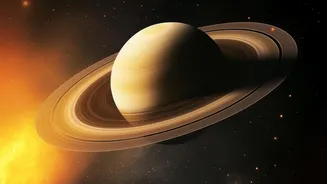
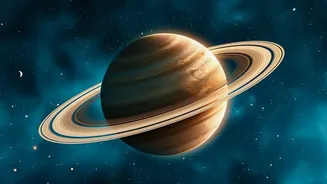
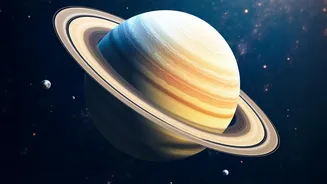
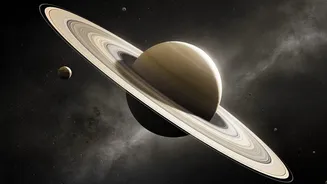
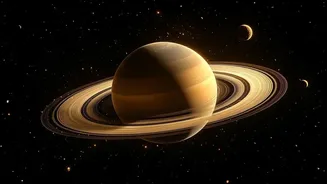
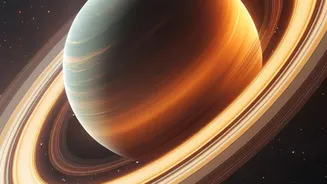
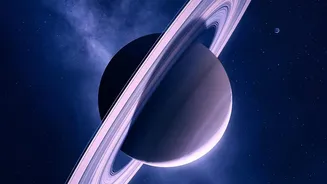
The leading theory behind the rings' demise is a process aptly named 'ring rain'. This isn't rain in the earthly sense, but a constant downfall of icy particles from the rings into Saturn's upper atmosphere. The particles that make up the rings, which
are mostly water ice, are being pulled inward by the planet's immense gravity. This process is influenced by Saturn’s magnetic field, which funnels the charged particles along invisible pathways down to the planet's surface. Scientists estimate this cosmic shower is draining the rings of an amount of water that could fill an Olympic-sized swimming pool every half an hour.
How Do We Know This Is Happening?
The first clues about ring rain came from NASA's Voyager spacecraft in the 1980s, which spotted strange, dark bands in Saturn's atmosphere. However, the most compelling evidence came decades later from the Cassini mission. Before its dramatic final plunge into Saturn in 2017, Cassini performed 22 dives between the planet and its rings. During these 'Grand Finale' orbits, its instruments directly sampled the material flowing inward, confirming it was a downpour of water, dust, and even complex organic molecules. This direct observation confirmed that the rings were not a closed system but were actively interacting with and feeding into the planet's atmosphere. Observations from ground-based telescopes like the Keck Observatory in Hawaii have also tracked the impact of this rain on Saturn's ionosphere, noting how it creates darker, less emissive bands where the water falls.
A Ticking Clock
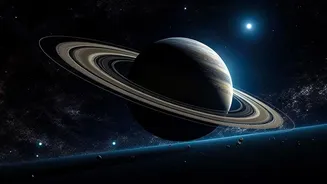
So, how long do Saturn's rings have left? Based on the rate of this ring rain, scientists have put forward a timeline. The most cited estimates suggest the entire ring system could be gone in as little as 100 million years, with a more conservative estimate at around 300 million years. While this sounds like an eternity to us, it's a very short period in cosmic terms, especially when compared to Saturn's age of over 4.5 billion years. This relatively rapid disappearance also feeds into another fascinating theory: that the rings themselves are a recent addition. The fact that they are over 95% pure water ice suggests they haven't been around long enough to be 'polluted' by a constant bombardment of darker interplanetary dust. Some studies propose the rings may be only 10 to 100 million years old, possibly forming around the time dinosaurs roamed the Earth.
A Fleeting Moment of Glory
The discovery that Saturn's rings are temporary fundamentally changes how we view our solar system. It suggests we are living in a particularly special time, a brief window of cosmic history where we can witness Saturn in its full glory. As scientist James O’Donoghue, a key researcher in this field, has noted, we are lucky to be around to see them at all. This raises the intriguing possibility that other giant planets like Jupiter or Neptune may have once hosted massive ring systems of their own, which have long since faded into the thin, wispy ringlets we see today. The process is not uniform; the innermost rings are expected to disappear first, with the outer rings following slowly over millions of years.