




Imagine a world with a thick, hazy atmosphere, where rivers carve channels into the landscape and vast seas stretch for hundreds of kilometres. This is Titan, Saturn's largest moon, but with a crucial twist: its lakes are not filled with water.
An Alien Analogy to Earth
At first
glance, Titan seems surprisingly familiar. It’s the only other body in our solar system known to have stable liquid on its surface, complete with clouds, rain, rivers, and seas. This has created a geologically diverse landscape that rivals Earth's. But the familiarity ends there. The surface temperature on Titan hovers around a frigid -179°C. At this extreme cold, water is frozen as hard as rock and forms the bedrock of the moon. The liquid that flows and fills the lakes is not water, but a mix of liquid hydrocarbons, primarily methane and ethane. These substances, which are gases on Earth, exist as liquids in Titan's deep freeze, creating an environment that is both strangely Earth-like and profoundly alien.
The Methane Cycle
Just as Earth has a water cycle, Titan has a methane cycle. Methane evaporates from the surface, forms clouds in the dense, nitrogen-rich atmosphere, and then falls back down as rain. These methane downpours feed the river systems and top up the lakes and seas, which are concentrated in the moon's colder polar regions. Data from the Cassini-Huygens mission, which studied the Saturn system extensively, provided definitive evidence for this cycle. Scientists observed lakes expanding and filling due to seasonal rainfall, confirming that Titan has active weather patterns driven by methane. This constant replenishing is crucial, as sunlight and chemical reactions in the upper atmosphere continually break down methane, meaning it must be sourced from somewhere to maintain its presence.
What Would It Be Like?
Standing on the shore of one of Titan's seas, like the massive Kraken Mare or Ligeia Mare, would be a surreal experience. The sky would be a thick, orange haze, with the sun appearing as only a faint bright spot. The gravity is much lower than on Earth, so you would feel significantly lighter. The liquid in the sea before you would be incredibly smooth, reflecting almost no radar signals back to space, giving it a dark, glassy appearance. The air would be thick with nitrogen and methane. While some lakes are vast and deep, others are smaller, steeper-sided depressions that scientists believe may form in a process similar to the creation of sinkholes on Earth, where the liquid hydrocarbons dissolve the icy bedrock. Some theories even suggest that pockets of warming nitrogen could have exploded in the past to create some of these basins.
A Cradle for Different Life?
The existence of liquid and complex organic chemistry makes Titan a prime target in the search for extraterrestrial life. This wouldn't be life as we know it, which relies on water. Instead, scientists speculate about the possibility of life using liquid hydrocarbons like methane as a solvent. Such life forms might breathe hydrogen instead of oxygen and metabolize different chemical compounds to survive. Recent studies have shown how vesicles—structures similar to the cell membranes of life on Earth—could potentially form naturally in Titan's methane lakes, perhaps sparked by splashing raindrops. While no evidence of life has been found, Titan is considered a giant laboratory for studying 'prebiotic' chemistry—the chemical steps that may have led to life on early Earth.
Future Exploration with Dragonfly
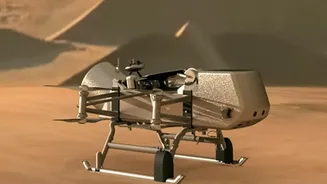
The next chapter in Titan's exploration is already planned. NASA's Dragonfly mission, scheduled to launch in 2028, will send a car-sized rotorcraft—essentially a flying drone—to the moon's surface. Arriving around 2034, Dragonfly will be the first powered aircraft to fly on another moon. Its goal is to fly between dozens of promising locations, including sand dunes and an impact crater where liquid water may have briefly existed. By drilling into the surface and analyzing samples, Dragonfly will investigate Titan's habitability, search for complex organic molecules, and probe the chemical origins of life itself. It will provide an unprecedented close-up view of this strange, hydrocarbon-rich world.