

Meet the 'Goldilocks' Gas Giant
In our solar system, gas giants come in one flavour: cold. Jupiter and Saturn orbit far from the Sun, making them frigid worlds. Many exoplanets discovered so far are the opposite: 'hot Jupiters' that orbit so close to their star they are scorched to thousands
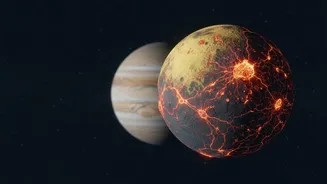
of degrees. Recently, however, astronomers have turned their attention to a much rarer class of planet: the temperate or warm gas giant. One such world is TOI-199b, a planet roughly the size of Saturn located over 330 light-years from Earth. With a temperature around 175 degrees Fahrenheit (79 Celsius), it occupies a 'Goldilocks' zone—not scorching hot, but far warmer than our own gas giants. This makes it an ideal laboratory for studying planetary atmospheres that are unlike anything we have close to home.
The Hunt for an Elusive Molecule
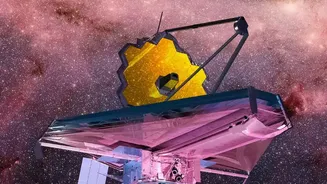
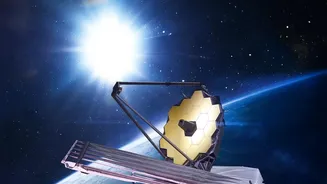
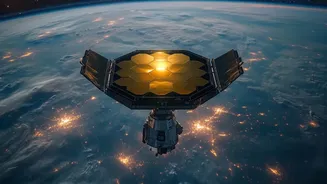
Methane is a common molecule in our own solar system, abundant in the atmospheres of Jupiter, Saturn, Uranus, and Neptune. However, detecting it on distant exoplanets has been surprisingly difficult. Using the powerful JWST, scientists were able to confirm the presence of methane in the atmosphere of TOI-199b. This discovery was significant because scientific models had long predicted that temperate gas giants should contain methane, and finding it provides crucial confirmation that our theories about planetary chemistry are on the right track. The finding represents a major step forward, as this is the first time the atmosphere of a temperate giant has been analyzed in such detail.
How to Read an Alien Atmosphere
Astronomers can't see TOI-199b directly. Instead, they use a clever technique called transmission spectroscopy. They wait for the planet to pass in front of its host star, an event known as a transit. As the starlight filters through the planet's atmosphere, some wavelengths of light are absorbed by the specific gases present. The JWST acts like a high-tech prism, splitting the starlight into a spectrum, or rainbow. By looking for the specific colours of light that are missing, scientists can identify the chemical composition of the atmosphere. In the case of TOI-199b, the telescope detected the tell-tale signature of methane blocking the starlight, and also gave hints of carbon dioxide and ammonia.
Why Methane Matters
Detecting methane is about more than just checking a box on a chemical inventory. The presence and amount of methane can tell scientists a great deal about a planet's formation, its internal heat, and its atmospheric processes. On some planets, methane is rapidly destroyed by starlight and must be constantly replenished from deeper within the atmosphere, hinting at vigorous vertical mixing. Studying these dynamics helps refine our models of how planetary atmospheres evolve over billions of years. Furthermore, while not the case for a gas giant like TOI-199b, methane is also considered a potential biosignature—a gas that could indicate the presence of life—on smaller, rocky worlds. Understanding how methane behaves in non-living atmospheres is essential context for the future search for life elsewhere.
A New Chapter in Planetary Science
The successful detection of methane on TOI-199b and other warm Neptune-like worlds such as WASP-80 b opens the door to a new era of comparative planetology. For the first time, we can perform an 'apples-to-apples' comparison of the chemistry of gas giants outside our solar system to our own familiar neighbours like Jupiter and Neptune. With further observations, scientists hope to determine the relative abundance of different gases on these worlds, painting a more complete picture of their nature. This work not only helps us understand the vast diversity of planets in our galaxy but can also offer new insights into the atmospheric processes that have shaped our own planet, Earth.