




A Cosmic Mystery In Omega Centauri
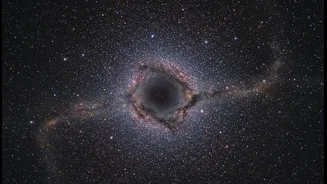
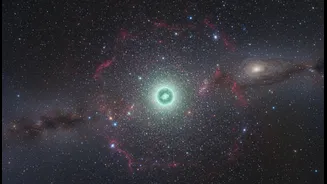
For decades, astronomers have been puzzled by Omega Centauri, the largest and most massive globular cluster orbiting our Milky Way galaxy. Located about 18,000 light-years away, this dense swarm of roughly ten million ancient stars has long been a subject
of intense study. Theoretical models predicted that a cluster this old and massive should be littered with thousands of stellar-mass black holes—the remnants of giant stars that collapsed at the end of their lives. Yet, for years, extensive searches turned up almost nothing. Scientists looked for the tell-tale X-rays and radio waves emitted by black holes actively feeding on nearby gas, but the cosmic giants remained silent and invisible, creating a persistent cosmic mystery. This lack of evidence was baffling, leading some to question the models of how star clusters and black holes evolve.
Finding the Invisible
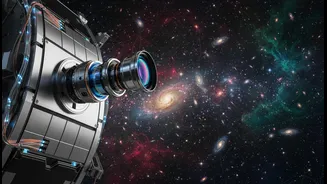
So how do you find an object that emits no light and has evaded detection for so long? The breakthrough came from using a different technique known as astrometry, which involves measuring the precise movements of stars over long periods. An international team of astronomers sifted through over 20 years of archival data from the Hubble Space Telescope and combined it with newer, highly precise observations from the James Webb Space Telescope. Instead of looking for a black hole directly, they searched for its gravitational influence on the stars around it. They were looking for a tell-tale wobble—a star moving in a way that suggested it was orbiting an unseen, massive companion.
The Telltale Wobble Reveals a Secret
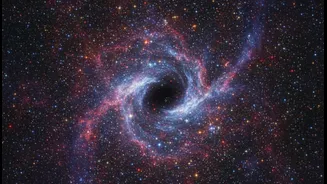
Deep within the crowded field of Omega Centauri, the team found exactly what they were looking for. They identified a star, weighing about three-quarters the mass of our Sun, that was locked in a slow, looping dance with an invisible partner. By tracking the star's leisurely orbit, which takes a staggering 94 years to complete, they could calculate the mass of the object it was circling. The calculations pointed to an object with a mass of about 4.5 times that of our Sun. This was too heavy to be a neutron star, the only other possible remnant of a dead star, which can't exceed about two solar masses. The only conclusion was that they had finally found one of Omega Centauri's missing stellar-mass black holes, now named oMEGACat BH-2.
A Discovery Full of Surprises
The discovery of oMEGACat BH-2 is significant not just because it's the first of its kind in this cluster, but also for its surprising characteristics. For one, its mass is lower than what models predicted for black holes forming in such an old, metal-poor environment. This challenges scientists to refine their theories about how massive stars evolve and die in ancient globular clusters. Furthermore, the 94-year orbit it shares with its companion star is the longest orbital period ever found for a black hole binary system. This discovery proves that even dormant, isolated black holes can be found through meticulous, long-term observation of the stars they gently pull on. It's a new and powerful method for hunting the hidden population of black holes thought to exist across our galaxy.
The First of Many?
Finding one black hole opens the floodgates. Astronomers believe this is just the tip of the iceberg, the first confirmed member of a population of up to 10,000 stellar-mass black holes predicted to be hiding in Omega Centauri alone. This discovery validates the detection method and gives scientists a powerful new tool to survey other globular clusters. Future observatories, like NASA's Nancy Grace Roman Space Telescope, will be able to conduct even wider and more regular searches, potentially uncovering hundreds or thousands more of these elusive objects. Each new discovery will provide crucial data, helping us understand not only the life cycle of stars but also the chaotic, gravitational dynamics that shape these ancient, glittering cities of stars over billions of years.