



Sending a command to a Mars rover and waiting up to 44 minutes for a response is a major hurdle in space exploration. A new approach called orbital computing promises to slash these delays, making missions smarter, faster, and more independent.
What is Orbital Computing?
At its
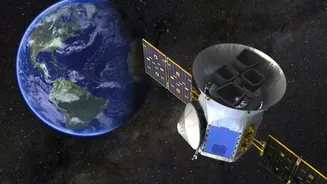
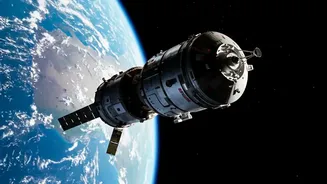
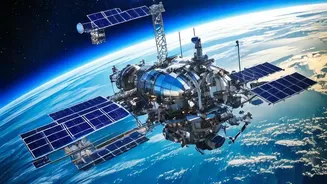
core, orbital computing—also known as in-space or edge computing—is about processing data where it is collected, directly on satellites and spacecraft, rather than sending it all back to Earth. Think of it as giving a spaceship its own brain. Traditionally, satellites and probes are like eyes and ears, capturing vast amounts of information and beaming it home through NASA's Deep Space Network. This new model equips the spacecraft itself with high-performance computing, often using powerful GPUs, to analyze data on the spot. This allows the mission to identify what is important, make decisions, and send back only the valuable insights, not the gigabytes of raw, unprocessed data.
The Problem with Phoning Home
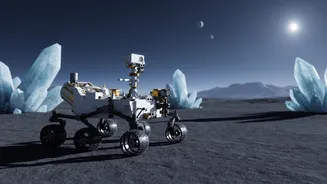
The current model of space exploration has a fundamental bottleneck: communication. The time it takes for a signal to travel from Earth to Mars and back can be up to 44 minutes. This delay makes real-time control impossible. If a rover spots a fleeting scientific event like a dust devil, the opportunity to study it is gone by the time mission control even sees the first images. Furthermore, space missions generate terabytes of data daily, but the bandwidth to send it all back to Earth is extremely limited and costly. This results in a slow, inefficient process where crucial data might wait weeks for analysis, and a significant portion is never even sent due to bandwidth constraints.
The Promise of True Autonomy
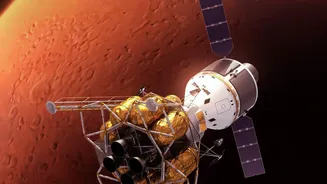
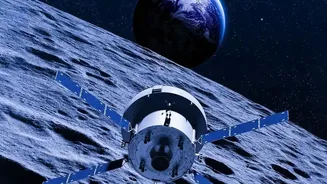
This is where orbital computing becomes a game-changer. By processing data locally, a spacecraft can react instantly to its environment. It could autonomously navigate around obstacles, adjust its course, or decide to investigate an unexpected geological formation without waiting for commands from Earth. This level of autonomy is crucial for deep-space missions to the outer planets, where communication delays can be hours long. It also enables new possibilities, like swarms of small satellites working together, coordinating their observations and actions to achieve a common scientific goal with minimal human oversight. For astronauts, it means having a reliable assistant that can analyze data in real-time, diagnose problems, and support experiments, making them more self-sufficient on long journeys to the Moon and Mars.
From Theory to Reality
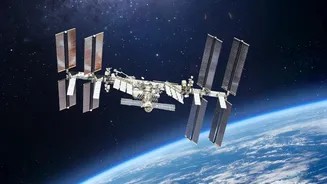
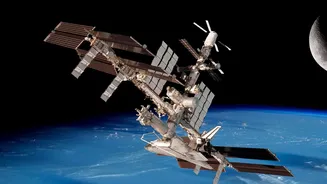
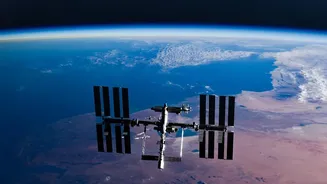
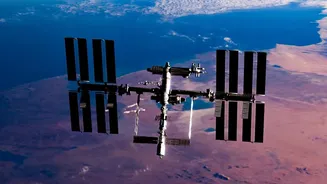
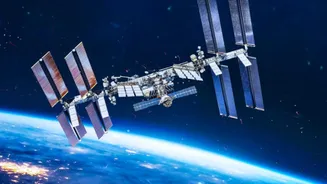
Orbital computing is no longer just a theoretical concept. Hewlett Packard Enterprise's Spaceborne Computer-2, a high-performance commercial computer, has been operating aboard the International Space Station (ISS) for several years. It has successfully run dozens of experiments, demonstrating its ability to process data far faster than sending it to Earth. In one stunning example, it analyzed a 1.8 GB DNA sequence in just six minutes, compressed the results, and sent them to Earth in two seconds—a process that would have traditionally taken over 12 hours just to download the raw data. Following this success, companies like AstroForge are planning missions for 2027 that aim to be fully autonomous after launch, relying on onboard AI to make all decisions without a single command from the ground.
Hurdles on the Final Frontier
Despite the promise, sending sophisticated data centers into space is not without challenges. The hardware must be rugged enough to withstand the harsh environment, including extreme radiation, solar flares, and unstable power, all of which can corrupt data and damage electronics. There are also significant thermal management issues, as high-performance computers generate heat that is difficult to dissipate in the vacuum of space. Developing software and AI algorithms that are reliable enough to entrust with billion-dollar missions is another major hurdle. The system must not only make good decisions but also be robust enough to handle unexpected failures far from any human help.