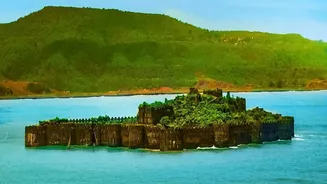





Rising from the Arabian Sea, the sea forts of Maharashtra are silent witnesses to centuries of conflict and trade. Among them, one stands supreme: Murud-Janjira. Let's delve into the architectural genius that made this fortress unconquerable.
An Impregnable Island Fortress
Dotted along
the Konkan coast, sea forts were the strategic guardians of maritime trade routes, but none are as legendary as Murud-Janjira. Located on an oval-shaped rock island near the coastal village of Murud, its name is believed to derive from the Arabic word 'Jazeera', meaning island. What began as a wooden structure built by local fishermen in the 15th century to defend against pirates was transformed into a formidable stone citadel in the 16th century. Credit for this stone fortification is often given to Malik Ambar, an Abyssinian military leader serving the Ahmadnagar Sultanate, around 1567. For centuries, this fort remained the stronghold of the Siddis, rulers of African origin, and earned its famous reputation as 'unconquered', having repelled attacks from the Portuguese, the British, and even the formidable Marathas.
A Masterpiece of Defensive Design
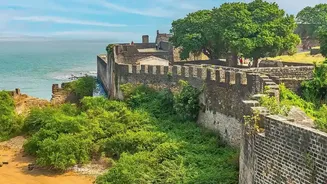
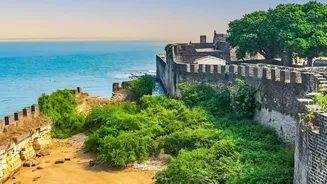
The fort's invincibility was no accident; it was the result of brilliant military engineering. The entire 22-acre complex is encircled by massive walls that soar approximately 40 feet high, seamlessly blending with the rock below. These walls, built from black rock, are punctuated by 19 rounded bastions, which remain impressively intact today. This design was crucial for deflecting cannon fire and providing a comprehensive defensive perimeter. The main entrance, known as the 'Darya Darwaza' or Sea Gate, faces the Rajapuri jetty but is ingeniously concealed, becoming visible only at close range—a feature designed to confuse and ambush approaching enemies. A striking sculpture near the gate depicts a tiger-like beast clutching elephants, a powerful symbol of the Siddis' strength against their mighty foes.
The Arsenal of Janjira
A fortress is only as strong as its firepower, and Janjira was exceptionally well-equipped. At its peak, the fort reportedly housed over 500 cannons. While most are now gone, some of the most formidable ones remain, including the famous 'Kalaal Baangadi'. This massive cannon, weighing over 22 tons, served as a powerful deterrent to any naval assault. The 26 surviving artillery towers provided strategic vantage points for spotting and engaging enemy ships long before they could get close. This combination of towering walls, concealed entrances, and overwhelming firepower made any direct assault on Janjira a near-suicidal mission for attacking forces.
A Self-Sufficient World Within
Beyond its military might, the architecture of Murud-Janjira was designed for longterm survival, allowing its inhabitants to withstand lengthy sieges. One of its most remarkable features is the presence of two large freshwater lakes inside the complex—a true feat of engineering on an island surrounded by saltwater. These tanks ensured a constant supply of drinking water for the garrison. The fort was a selfcontained township, with ruins of palaces, quarters for officers, a mosque, and storage facilities for grain and ammunition. This internal infrastructure meant the fort could function independently for extended periods, severing its reliance on mainland support and further solidifying its legendary invincibility. Secret passages and a rear gate opening to the sea also provided an escape route if ever needed.