



The River Paradox
Often recognized for its vast salt desert, the Rann of Kutch, the district of Kutch in Gujarat harbors a secret that confounds many: an abundance of rivers.
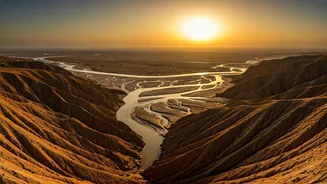
While India boasts mighty waterways like the Ganga and Brahmaputra, Kutch presents a unique geographical marvel with approximately 97 rivers flowing through its expanse. This statistic, often posed as a challenging general knowledge question, highlights how a region predominantly perceived as arid actually possesses a complex and extensive riverine system. These waterways contribute to a distinctive natural drainage pattern, either finding their way to the Arabian Sea or disappearing into the expansive Rann of Kutch, showcasing nature's adaptability even in harsh environmental conditions. The sheer number of these rivers underscores a remarkable aspect of Kutch's geography, transforming its arid reputation into one of a surprising water-rich territory, albeit with a peculiar seasonal existence.
Seasonal Waterways
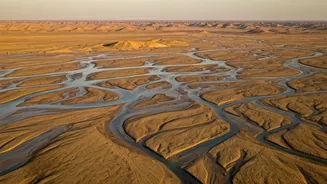
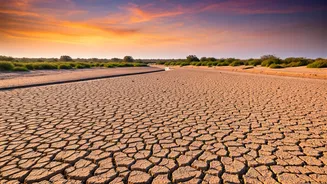
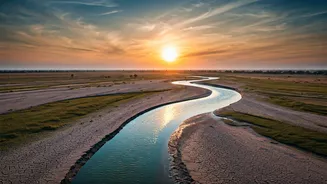
The rivers of Kutch are characterized by their predominantly seasonal nature. While Gujarat is home to around 185 rivers, a significant portion, nearly 97, are associated with Kutch. The defining characteristic of most of these is their ephemeral existence; they spring to life only during the monsoon season, carrying water for a limited period before receding into dry, sandy beds for the remainder of the year. This cyclical flow means that the landscape transforms dramatically between the wet and dry seasons. Even with arid conditions and desert terrain, Kutch demonstrates nature's ingenuity in creating numerous channels for water flow, which are crucial during the brief monsoon spell. The water in some of these rivers can also become saline, which poses challenges for its usability for everyday purposes, further emphasizing their unique status.
Prominent and Lesser-Known
Among the many rivers gracing Kutch, several are more recognizable, including Rukmavati, Suvi, Malan, Saran, Sakar, Mithi, Ghurud, Vekhdi, Chang, Khari, Nara, Panjora, Kharod, Kotri, Kali, Kanakavti, and Rudramata. Beyond these named watercourses, a multitude of smaller streams emerge solely during periods of rainfall, contributing to the district's intricate drainage network. These smaller tributaries, like their larger counterparts, gradually vanish as the monsoon season concludes. The collective impact of these numerous rivers, both large and small, is substantial. They form a vast and complex drainage system, with a significant number of them emptying directly into the Arabian Sea or becoming absorbed by the immense salt flats of the Rann of Kutch, shaping the district's unique hydrological character.
Drainage Dynamics
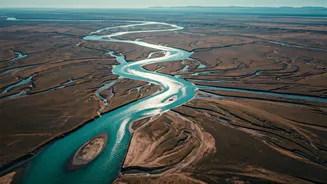
The ultimate destination for many of Kutch's rivers is either the Arabian Sea or the vast, iconic Rann of Kutch. This geographical feature dictates a unique drainage pattern for the region. Rivers such as Banas, Saraswati, Rupen, Luni, Machhu, Ghodadhroi, Brahmani, Khari, Phalki, Nara, Suvi, Pur, and Bhurud are integral parts of this extensive system. Their journey concludes either by flowing into the sea, a common fate for many rivers, or by merging with the saline expanse of the Rann. This dispersal into the desert landscape is a defining trait, contributing to the region's arid environment while also being a vital part of its ecosystem during the monsoon. The interplay between these rivers and the Rann creates a dynamic environment, a testament to the diverse ways water shapes landscapes, even in seemingly inhospitable terrains.