





A New Era of Travel
For generations, the journey to the revered Haji Malang Dargah and the ancient Malanggad Fort near Kalyan in Maharashtra was a testament to devotion, often
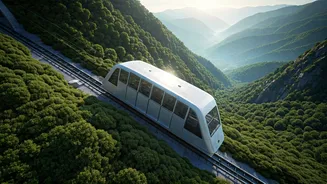
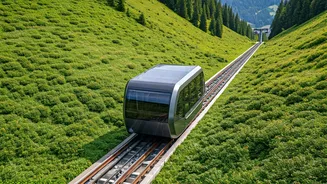
involving a grueling climb of over 2,500 stone steps. This arduous ascent could take up to two hours, posing a significant challenge, particularly for the elderly and those with mobility issues. However, with the advent of the Shri Malanggad Funicular Railway, this age-old struggle has been replaced by a smooth, rapid transit experience. Launched in early 2026, this 1.2 km track has not only redefined the pilgrimage but also claimed the title of India's only true funicular railway, superseding previous notions held about the Matheran toy train's status.
The Genius of Funiculars
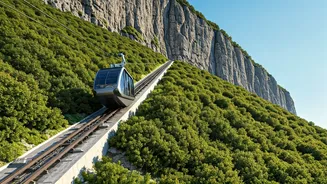
At its core, a funicular railway is a marvel of ingenious engineering designed to conquer steep gradients. Unlike conventional trains that rely on powerful engines, a funicular operates on a brilliant counterbalancing principle. It consists of two cars attached to a single cable that runs over a pulley system at the top of the incline. As one car ascends the mountain, the other descends simultaneously, their weights naturally balancing each other. This elegant design significantly reduces the energy expenditure required for operation, making it an efficient and sustainable solution for traversing challenging, mountainous terrain. The Shri Malanggad system exemplifies this principle, utilizing its steep 33-degree incline to its advantage.
Transforming the Pilgrimage
The impact of the Shri Malanggad Funicular Railway on visitors, especially those making the spiritual journey to Haji Malang Dargah, is profound. The arduous trek, which once demanded significant physical exertion and time, is now accomplished in a mere ten minutes. This drastic reduction in travel time has made the pilgrimage accessible to a much wider demographic. Elderly devotees, who might have found the traditional climb insurmountable, can now reach the shrine with ease and comfort. Families, including those with young children, can embark on the journey together without the fear of exhaustion, often finding the ride itself to be an enjoyable experience, turning a daunting task into a pleasant expedition.
Engineering a Steep Ascent
The Shri Malanggad Funicular Railway stretches for just over a kilometre, navigating a substantial incline of 33 degrees as it ascends the mountain. This gradient makes it the longest funicular system of its kind in India. The track's sharp rise is a clear indicator of the challenging topography it overcomes, gaining several hundred metres in elevation from its base. The sheer steepness of the terrain underscores the necessity for such a specialized transport system. Each ride is designed to carry a substantial number of passengers, with a capacity ranging from 90 to 120 individuals, ensuring efficient movement of large groups of pilgrims and visitors.
From Vision to Reality
The inception of the Shri Malanggad Funicular Railway project dates back to around 2006, with the primary objective of alleviating the difficulties faced by devotees. The initial conception was driven by a desire to make the pilgrimage to Haji Malang Dargah more manageable for everyone. The steep mountain slopes and the complex terrain presented considerable engineering hurdles that needed careful consideration and innovative solutions. Once the project was finalized for execution, the estimated cost was pegged at approximately Rs 90 crores, reflecting the significant investment required to bring this ambitious vision to fruition.
Overcoming Construction Hurdles
The construction of the Shri Malanggad Funicular Railway was a formidable undertaking, primarily due to the geological nature of the Malanggad hills. These hills are composed of hard basalt rock, a material that demands extensive and meticulous planning for excavation and construction. In many areas, the limited space available on the steep slopes posed significant challenges for deploying heavy machinery and equipment. Furthermore, the region's characteristic monsoon season frequently disrupted progress. The heavy rainfall would render the slopes unsafe for workers, leading to delays and extended construction timelines. These harsh environmental conditions were major factors contributing to the project's lengthy completion period.
The Balancing Act
The operational mechanism of the funicular railway is a fascinating study in applied physics and engineering. The system's elegance lies in its balance-based design, where two coaches are perpetually linked by a single, robust cable. This connection ensures that as one coach embarks on its upward journey, the other simultaneously begins its descent. Imagine a long rope draped over a pulley – the principle is remarkably similar. The collective weight of the descending car actively assists in pulling the ascending car, thereby minimizing the external energy input required. This intelligent use of gravity and counterweight makes the funicular an efficient and energy-conscious mode of transport, particularly suited for steep ascents.
A Boon for Visitors
The transformation brought about by the Shri Malanggad Funicular Railway is immediately apparent to anyone who uses it. The once-demanding, hours-long ascent has been compressed into a brief, comfortable ten-minute ride. This change has been particularly life-altering for pilgrims who are elderly or have physical limitations, removing the barrier of exhaustion that previously prevented them from reaching the sacred site. For families, the journey is no longer a concern but a shared, enjoyable experience, making the pilgrimage inclusive and far more pleasant for all members. The overall visitor experience has been elevated, making access to this important religious destination significantly easier and more enjoyable.