







The Latitude Paradox
The 'Latitude Paradox' is a captivating concept. It challenges the conventional wisdom that countries at higher latitudes, closer to the poles, automatically
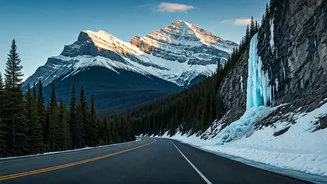
receive the most snowfall. While places like Canada, Norway, and Greenland are often associated with snowy landscapes, they don't necessarily hold the record for the most snowfall. This paradox highlights that other factors, such as geographical features and weather patterns, have a significant influence on snowfall accumulation. Japan, despite being at a lower latitude than many snow-prone regions, consistently experiences remarkable snowfall due to a unique combination of conditions, debunking the simple equation of latitude and snowfall volume. This interplay leads us to explore the factors responsible for the heavy snowfall experienced in Japan.
Sea of Japan's Warmth
The Sea of Japan plays a pivotal role in the country's impressive snowfall. Unlike many other seas, the Sea of Japan remains relatively warm even during the winter months. This warmth acts as a significant energy source, providing the moisture needed for heavy snowfall. When cold air masses from Siberia move over the warm waters, they absorb moisture and heat, becoming laden with water vapor. As these moisture-rich air masses rise and encounter the Japanese archipelago, they are forced to ascend over the mountains, leading to significant precipitation. This is particularly noticeable on the western side of Japan, where the air is pushed upward, causing the water vapor to condense and fall as snow. This continuous supply of moisture from the warm sea is a key component contributing to Japan's record-breaking snowfall.
Japan's Mountainous Terrain
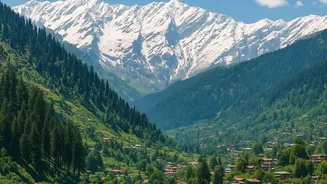
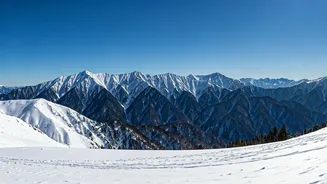
Japan's mountainous landscape further enhances its snowfall potential. The islands are characterized by a series of steep mountain ranges that run along the length of the country. This rugged terrain acts as a physical barrier that forces the moisture-laden air masses coming from the Sea of Japan to rise. As the air is pushed upwards, it cools, and the water vapor it carries condenses, forming snow. This 'orographic lift' effect is a major contributor to the heavy snowfall. The mountains act like a giant ramp, forcing the air upwards and wringing out the moisture as snow. Because of this, the western slopes of the Japanese mountains often experience significantly higher snowfall than the eastern slopes, creating a dramatic disparity across the country. The complex interplay between the mountains and the weather systems is integral to Japan's winter phenomenon.
Siberian Cold Air
The frigid air from Siberia delivers the 'kick' needed to transform the moisture from the Sea of Japan into copious amounts of snow. During winter, high-pressure systems develop over Siberia, resulting in a continuous outflow of extremely cold air. This cold air mass flows across the Sea of Japan, where it picks up moisture and heat. The interaction of the cold Siberian air and the warm sea creates an unstable atmosphere, which results in the formation of large snow clouds. When this moisture-laden, cold air reaches Japan's mountainous terrain, the orographic lift causes the clouds to release massive amounts of snowfall. The stronger the Siberian high-pressure system, the colder the air, and the more snowfall Japan receives, highlighting a close correlation between these two regional weather patterns.
Perfect Storm of Snow
The remarkable snowfall in Japan is a direct outcome of a perfect alignment of geographic and meteorological factors, creating the 'perfect storm of snow.' The warmth of the Sea of Japan is the fuel, supplying moisture to the air. The mountainous terrain is the catalyst, forcing the air to rise and release its precipitation. The Siberian cold air mass is the engine that drives this process, providing the necessary chill to turn the moisture into snow. The combined effect of these three factors leads to truly exceptional snowfall amounts in many parts of the country, especially on the west coast, giving rise to its reputation as a winter wonderland. This is a complex interplay of natural forces working in concert to create the winter scenes that Japan is famous for.
Record-Breaking Snowfall
Japan's geographical and atmospheric conditions conspire to produce some of the highest snowfall totals in the world. Several areas, particularly those facing the Sea of Japan and nestled within mountainous regions, consistently experience record-breaking snowfall. These locales often accumulate several meters of snow annually, making winter a very significant season. The sheer volume of snow is often a challenge, but also a source of beauty and a key element of the region's economy and culture. The intensity of the snowfall requires a sophisticated infrastructure for management and also drives local tourism. Japan's snow-rich areas, therefore, provide a fascinating study in environmental dynamics and how humanity adapts to the power of nature.
Common Assumptions Challenged
The common assumptions about snowfall distribution are challenged by the reality of Japan's experience. It’s easy to assume that higher latitude countries, like those in the Arctic circle, would see the greatest snowfall. However, factors like the presence of a warm sea, the layout of the landscape and the influence of cold continental air, mean that Japan accumulates significantly more snowfall than many countries that are located further north. This shows the importance of looking beyond latitude when we think about snowfall. The Japanese case provides a valuable lesson in the complexities of climate. It reveals how regional variations and interactions of geographical characteristics can disrupt standard assumptions and lead to surprising meteorological outcomes.