








Introducing the Raider
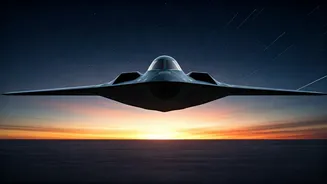
The United States Air Force is ushering in a new era of aerial combat with the B-21 Raider, its latest stealth bomber developed by Northrop Grumman. This
aircraft is engineered to execute far-reaching strike missions and is slated to gradually take over the duties of older bombers, such as the B-2 Spirit. The estimated cost for each B-21 Raider is a significant investment, reportedly around $700 million, which translates to approximately Rs 6,440 crore. Its introduction signifies a major leap in America's air power capabilities, enabling operations deep within hostile territory to neutralize critical targets. The design prioritizes extreme stealth, making it exceptionally difficult for conventional radar systems to detect, augmented by sophisticated electronic warfare systems.
Advanced Technological Core
At the heart of the B-21 Raider lies a suite of cutting-edge technologies. It is understood to be outfitted with advanced sensors, communication systems that feature robust encryption, and artificial intelligence-assisted avionics. A key design feature is its open-architecture framework, which is a strategic advantage, allowing the U.S. Air Force to implement software, weapons, and sensor upgrades with relative ease as new technological advancements emerge. This adaptability ensures the bomber remains at the forefront of military aviation for years to come. The physical design incorporates a flying-wing configuration, building on the legacy of previous stealth aircraft but enhancing its radar-evading properties. Special considerations in its construction include engine inlets, specialized coatings, and internal weapon bays, all meticulously designed to minimize both radar cross-section and heat signatures, thereby evading even the most sophisticated air-defense networks.
Payload and Strategic Reach
The B-21 Raider is engineered for profound strategic impact, capable of carrying a substantial payload within its internal weapon bays. It can reportedly house around 30,000 pounds (approximately 13,600 kg) of ordnance. This arsenal can include a diverse range of munitions, such as nuclear-capable bombs for strategic deterrence, precision-guided Joint Direct Attack Munitions (JDAMs) for accurate targeting, and potent long-range cruise missiles like the JASSM-ER. This versatility ensures the Raider can be employed effectively against a wide spectrum of targets, from hardened infrastructure to mobile enemy assets. The aircraft's impressive range is another critical factor; it is designed to traverse more than about 6,000 miles (around 9,600 km) on a single tank of fuel, making it an exceptionally capable platform for global power projection. Its maximum operational speed is reported to be close to Mach 0.95, which is approximately 1,000 km/h, allowing for swift ingress and egress from operational areas.
Mid-Air Refueling Capability
For missions requiring extended operational time or transcontinental reach, the B-21 Raider is equipped for aerial refueling. This capability significantly amplifies its global operational potential, allowing it to remain airborne and on station for prolonged periods, far beyond its inherent range. The refueling process involves a dedicated tanker aircraft, such as the KC-46 Pegasus. The transfer of fuel typically takes between 15 to 20 minutes, during which a specialized boom extends from the tanker and connects to a receptacle on the bomber. This procedure is crucial for enabling the Raider to conduct its long-range strike missions effectively, ensuring it can reach distant targets, loiter if necessary, and return safely, thereby enhancing its strategic flexibility and survivability in complex operational environments.
Future Air Power Vision
The B-21 Raider represents a cornerstone of the United States' future air power strategy. As of 2026, at least two of these advanced bombers are in service, with plans for further production over the coming decades. The U.S. Air Force intends to build a significant fleet of B-21 stealth bombers, underscoring their importance in maintaining air superiority in an increasingly complex global security landscape. Its deployment is seen as a direct response to evolving threats and the need for a penetrating strike capability that can overcome sophisticated air defense systems. The bomber's advanced design, stealth characteristics, and payload capacity position it to be a critical asset for decades to come, ensuring that America retains a formidable and adaptable air combat capability.