





Barringer Crater's Majesty
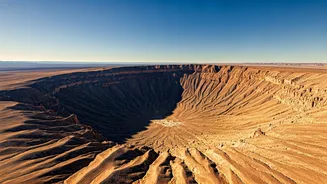
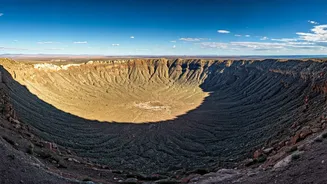
Located near Winslow, Arizona, the Barringer Crater stands as a pristine example of a terrestrial impact site, profoundly shaped by a meteorite collision
approximately 50,000 years ago. This immense depression, spanning roughly 1.2 kilometers in diameter and plunging about 170 meters deep, was created by an iron meteorite estimated to weigh around 300,000 tons. The sheer force of this impact is evident in the uplifted rim, which stands about 45 meters above the surrounding plains, and the shattered bedrock extending outward. Scientists have found significant amounts of iron-nickel alloy within and around the crater, confirming its extraterrestrial origin. The site is privately owned and remarkably well-preserved, offering visitors an unparalleled opportunity to witness the raw power of a cosmic event firsthand. Walking along the rim or exploring the interpretive center provides a deep appreciation for the scale and impact of this ancient celestial encounter, making it a must-see for geology enthusiasts and curious travelers alike.
Lonar Crater's Mystery
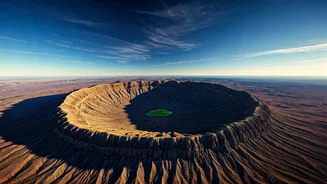
Nestled in the state of Maharashtra, India, the Lonar Crater is a unique saline, alkaline lake formed by a meteor impact an estimated 50,000 years ago. This basaltic impact structure is remarkable for its distinct geological characteristics and the diverse ecosystem it supports. The crater itself measures approximately 1.8 kilometers in diameter and 137 meters deep, with the lake occupying its basin. The water's unique chemical composition, a blend of fresh and saline, has long intrigued scientists, leading to studies on extremophile microorganisms thriving in its environment. Surrounding the lake are basaltic rock formations and lush vegetation, creating a picturesque setting. Visitors can explore the crater rim, descend to the lake's edge, and visit ancient temples scattered around the site, adding a layer of historical and spiritual significance to the natural wonder. The Lonar Crater offers a fascinating blend of cosmic history and biological uniqueness.
Puchezh-Katunka's Scale
The Puchezh-Katunka structure in Russia's Nizhny Novgorod Oblast is one of the largest and best-preserved impact craters on Earth, dating back approximately 160 million years to the Middle Jurassic period. This colossal structure measures an astounding 200 kilometers in diameter, though much of its original form has been eroded or buried over geological time. The impact event that formed Puchezh-Katunka was of immense magnitude, likely creating a cataclysmic scene that profoundly altered the regional landscape. While its surface features are not as immediately striking as younger craters due to extensive weathering and sedimentation, geological surveys and seismic data reveal the subsurface structure of a massive impact basin. Research indicates the presence of shock-metamorphosed rocks, providing critical evidence of the high-energy collision. Exploring this site offers a profound sense of Earth's deep history and the immense forces that have shaped our planet over eons.
Tenoumer Crater's Arid Beauty
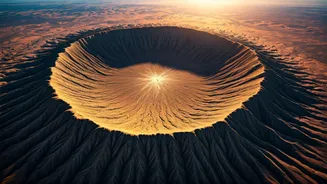
Located in the desert region of Mauritania, West Africa, the Tenoumer Crater is a striking circular feature that serves as a testament to ancient extraterrestrial impacts. Estimated to have formed around 2.5 million years ago, this impact structure is approximately 1.9 kilometers in diameter and features a well-defined rim against the arid landscape. The geological evidence suggests a moderate-sized meteorite striking the Earth, leaving behind this distinct, bowl-shaped depression. The surrounding desert terrain, characterized by sand dunes and sparse vegetation, provides a stark and beautiful backdrop to the crater. While not as frequently visited as some other impact sites due to its remote location, Tenoumer offers a raw and powerful visual of Earth's encounter with celestial bodies. Its preservation in the dry desert climate allows for a clear appreciation of the impact's geometry and the geological forces involved.
Gosses Bluff's Outback Gem
In the remote Australian Outback of the Northern Territory lies Gosses Bluff, a unique geological structure formed by a meteorite impact approximately 142 million years ago. This ancient impact site is not a typical crater but rather a complex uplifted dome with a surrounding ring of hills, evidence of the immense pressure exerted during the impact that caused the Earth's crust to buckle and rebound. The original crater is believed to have been around 22 kilometers in diameter, but erosion over millions of years has sculpted the landscape into its current distinctive form. The central uplift, reaching heights of over 450 meters, is a dramatic feature surrounded by a series of concentric ridges. Visiting Gosses Bluff offers an immersive experience into the vastness of the Outback and a compelling geological puzzle, showcasing how impact events can create enduring and spectacular landforms over immense timescales.