




The Invisible Menace
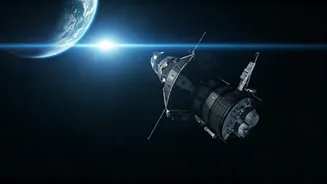
Despite the increasing volume of discarded satellites and mission fragments cluttering Earth's orbit, space debris remains remarkably elusive in photographic
evidence from space missions. Even with the advent of high-resolution cameras and the growing awareness of potential orbital hazards like the Kessler Syndrome – a cascading chain reaction of collisions creating more debris – these objects are rarely, if ever, captured in imagery. The sheer speed at which both spacecraft and debris travel, often exceeding 17,500 mph, renders them fleeting blips, if visible at all. While millions of fragments larger than a centimeter and tens of millions smaller ones populate our orbital paths, their detection in photographs requires exceptionally precise and unlikely conditions. The primary reason for this invisibility is the diminutive size of most debris; they are simply too small to be resolved by the human eye or even by standard camera equipment, making their presence in iconic mission photos a virtual impossibility.
Challenges of Capture
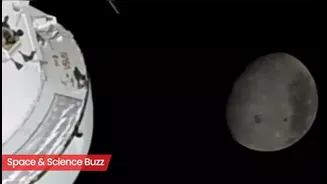
The likelihood of photographing space junk during a space mission, even one as ambitious as Artemis II, is astronomically low. For an astronaut to successfully capture an image of a piece of debris, a confluence of nearly perfect circumstances would be necessary. The fundamental obstacle is the immense relative velocity between the spacecraft and any potential debris. Both entities are hurtling through space at speeds that make clear visual identification and photographic capture exceptionally difficult. Even if a larger piece of debris were present in the vicinity, the brief window of opportunity to focus and take a clear shot, coupled with the inherent motion blur, significantly diminishes the chances of obtaining a usable image. Thus, while the threat of debris is real, its photographic representation remains a rare and serendipitous event, requiring conditions far beyond the typical operational scope of a space mission.
Orbital Location Matters
The typical location of most space debris plays a significant role in its invisibility in mission photos. The densest concentrations of orbital debris are found in low Earth orbit, generally situated between approximately 466 and 621 miles above the planet's surface. Missions like Artemis II, which venture much further into space, particularly towards the Moon, are therefore less likely to encounter this high-density debris field. Furthermore, during the critical initial phases of a launch, astronauts are intensely focused on navigating the spacecraft through its ascent and critical flight operations. This demanding period leaves virtually no time for external observation or the opportunistic photography of anything passing by. The spacecraft's rapid progress means that even substantial objects would be gone in an instant, making detailed photographic documentation an unrealistic expectation under such circumstances.
Safety Amidst Space
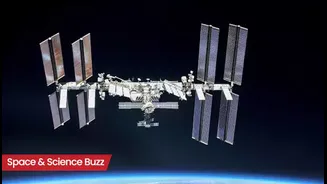
While the difficulty of photographing space junk might suggest astronauts are completely isolated from it, this is not the case. The International Space Station (ISS), for instance, regularly experiences encounters with minuscule debris particles. However, the ISS is engineered with robust shielding designed to withstand impacts from these tiny fragments. The probability of a catastrophic collision with a larger object remains relatively low. Space, despite the debris concerns, is vast, with celestial bodies and objects situated at enormous distances from one another. Therefore, while the issue of space debris is a serious ongoing concern for space agencies, it does not equate to a constant bombardment of astronauts or spacecraft. Advanced tracking systems are diligently employed to monitor potential threats, ensuring astronaut safety during spaceflights and mitigating risks associated with orbital clutter.