







Amritsar to Attari: Historical Echoes
Take a brief yet impactful 25-kilometer train ride from Amritsar to Attari, a journey that lasts about 40-45 minutes and costs a mere ₹10. This route,
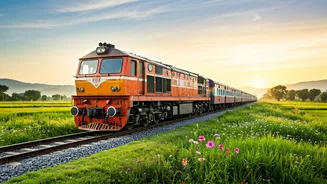
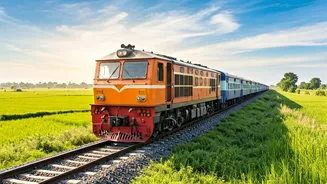
stopping at Chheharta and Khasa, leads to Attari, a station nestled very near the international border with Pakistan. Historically, this very railway line served as a vital connection between Amritsar and Lahore before the subcontinent's partition. Imagine that without the border, Lahore would be just a short hop further down this same track. The scenery along the way unfolds into expansive, verdant fields and quaint, small villages. Keep an eye out for Border Security Force training exercises near Khasa. Attari station itself is a testament to the colonial era, boasting an international platform that once welcomed trains plying between India and Pakistan. The area's main draw is the world-renowned Attari–Wagah border ceremony. Nearby, you can explore Sarai Amanat Khan village, Pul Kanjri, established by Maharaja Ranjit Singh, and Sham Singh Attari Park, which houses a museum dedicated to the esteemed Sikh general. Trains depart from Amritsar to Attari at 07:30 am and 06:20 pm, with return services from Attari to Amritsar running at 08:20 am and 07:15 pm.
Amritsar to Dera Baba Nanak: Spiritual Serenity
Embark on a peaceful 55-kilometer journey from Amritsar to Dera Baba Nanak, a trip that takes approximately 1 hour and 20 minutes and is priced at just ₹15. The train makes several stops, including Verka, Majitha, Ramdas, Rattar Chattar, and Hardowal, before reaching the historically significant town in the Gurdaspur district. Along this route, you'll encounter charming colonial-era station buildings, often adorned with vibrant bougainvillea. Verka station, in particular, has a distinctive architectural style reminiscent of hill-station bungalows, while Hardowal offers a tranquil rural ambiance. Glimpse passing farms, farmers working their fields, and villagers going about their daily lives as the train glides through the countryside. Dera Baba Nanak holds profound religious significance, being closely linked to the final years of Guru Nanak Dev Ji's life. The town is situated across the Ravi River from Kartarpur in Pakistan, the site of the revered Gurdwara Darbar Sahib Kartarpur. This location is the starting point for the Kartarpur Corridor, a special passage that allows Indian Sikh pilgrims to visit the shrine in Pakistan visa-free when operational. Visitors can also immerse themselves in the spiritual atmosphere of the Darbar Sahib gurdwara and Sri Chohla Sahib, and explore the local marketplace. Train schedules from Amritsar/Verka to Dera Baba Nanak are at 04:20 am, 10:30 am, 02:15 pm, and 05:50 pm, with return services departing at 06:05 am, 12:15 pm, 04:00 pm, and 07:20 pm.
Amritsar to Khem Karan: Echoes of Conflict
The most extensive of these three routes spans 77 kilometers from Amritsar to Khem Karan, requiring about two hours for the journey and costing ₹20. Some services originate from Bhagtanwala station, situated near Amritsar. The train traverses through numerous small halts within the Taran Taran district, providing an intimate view of rural Punjab's landscape. Khem Karan carries significant historical weight as the location of the Battle of Asal Uttar during the 1965 Indo-Pakistani War. It was here that Indian forces successfully repelled a major Pakistani armored advance, leaving behind abandoned tanks scattered across the fields – an event famously remembered as the "Graveyard of Tanks." Nearby, adjacent to the border fence, are two unique shrines: Gurdwara Sahib Singh Shaheed and Sheikh Braham Dargah. Accessing these sites necessitates passing through Border Security Force checkpoints. Be advised that photography is strictly prohibited, and all electronic devices must be surrendered to the BSF before entering the restricted area. Departures from Amritsar/Bhagtanwala to Khem Karan are scheduled for 04:40 am, 09:15 am, 01:35 pm, and 06:10 pm, with return trains departing at 06:50 am, 11:25 am, 03:35 pm, and 08:10 pm.
Cinematic Narratives and Landscapes
The railway corridor between Amritsar and Attari has not only witnessed history but has also served as a backdrop for Indian cinema, enhancing its narrative power. For instance, the tracks featured in the film 'Bajrangi Bhaijaan' underscore the profound emotional connections that transcend the India-Pakistan border. Attari station itself was a filming location for 'Veer-Zaara,' a cinematic tale centered on love stories that spanned across both nations. The quietude of the station and the now-closed railway line at the frontier evoke a palpable sense of separation and remembrance, resonating with the film's themes. Similarly, the modest railway station at Dera Baba Nanak has also garnered attention on the silver screen. It was recently showcased in 'Gustaakh Ishq,' a film that celebrated the inherent charm of small-town Punjab and its antiquated railway architecture. These cinematic portrayals further imbue these routes with layers of cultural significance and emotional depth, making the journeys more evocative.
Winter's Embrace on Rural Rails
Experiencing these train routes during the winter months offers a uniquely captivating spectacle. Mornings in December, particularly around Amritsar and Attari, are often veiled in a dense fog that blankets the expansive fields. This atmospheric condition softens the landscape into subtle shades of grey and green, creating a dreamlike panorama. As the train progresses, the ever-changing vista of wide farmlands, distant hamlets, and expansive open skies unfolds outside the windows, painting a picture of profound tranquility. The stillness of the winter air, combined with the gentle rhythm of the train, enhances the peacefulness of the journey, making it a serene escape into the heart of rural Punjab. The visual poetry of the fog-laden fields and the quietude of the countryside offer a distinct charm that is particularly memorable during this season.
Border Shrines and Security Protocols
The shrines located near Khem Karan are situated in extremely close proximity to the international border, necessitating stringent security protocols for access. Visitors are required to pass through Border Security Force (BSF) checkpoints and must present valid identification documents. Crucially, all electronic devices, including mobile phones and cameras, are prohibited and must be deposited with the BSF personnel prior to entering the shrine vicinity. Photography is strictly forbidden in this sensitive area. These measures are in place to ensure border security and maintain the sanctity of the locations. While the access is regulated, the experience of visiting these spiritually significant sites near the frontier offers a unique perspective on the region's complex geopolitical landscape and its cultural heritage.
Preserving Colonial Railway Heritage
Many of the railway stations along these scenic routes continue to stand as fine examples of colonial-era architecture, contributing to the nostalgic charm of the journeys. However, the preservation of these historic structures is uneven. Some of these venerable buildings have unfortunately fallen into neglect or have been demolished over time. This includes the former stations at Chheharta and Khasa on the Attari route, which are no longer in their original form. The stations that have managed to survive, particularly those along the Dera Baba Nanak line, remain visually striking and possess significant historical value. Efforts towards their restoration could transform them into compelling heritage attractions, drawing visitors interested in the railway history of India and showcasing the architectural legacy of the British Raj.
Punjab's Hidden Travel Gems
These three distinctive local train excursions offer a profound glimpse into an often-overlooked facet of Punjab, revealing a tapestry of serene villages, vast agricultural expanses, and narratives deeply interwoven with history. With ticket prices so low—often less than the cost of a meal in a city—travelers can immerse themselves in picturesque landscapes, explore intriguing border towns, and connect with significant historical sites. These journeys are facilitated by simple, everyday trains that continue to serve the local communities, embodying the authentic spirit of the region. They represent an accessible and deeply rewarding way to experience the cultural and historical richness of Punjab, far from the usual tourist trails.