







The USB Evolution
The term USB-C has become ubiquitous, often mistakenly associated solely with charging capabilities. However, the 'C' doesn't stand for 'charging' or 'compact'
as some might assume. Instead, it represents the third major iteration in the lineage of Universal Serial Bus connectors. Before Type-C arrived, there were its predecessors, Type-A and Type-B, each with distinct characteristics and limitations. Understanding these earlier forms is crucial to appreciating the advancements brought forth by the current standard. These initial designs laid the groundwork for a more unified and efficient digital experience, though they came with their own set of user-facing quirks and design constraints that Type-C would ultimately resolve.
Meet the USB Family
Before the advent of the reversible USB-C, two other connector types dominated the landscape. First, there's USB Type-A, the familiar, rectangular plug commonly found on computer ports and wall adapters. Its design is inherently unidirectional, meaning it can only be inserted one way, often leading to fumbling. Then came USB Type-B, which, much like the Micro-USB ports found on older smartphones, featured an asymmetrical shape. This design, wider on one end and narrower on the other, also presented a risk of damage if users attempted to force it into a port upside down. These predecessors highlight the persistent challenges of connection orientation that users faced for years, setting the stage for a more user-friendly solution.
The Type-C Advantage
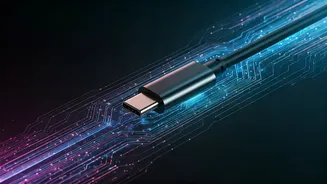
USB Type-C has rapidly ascended to become the de facto global standard for electronic connectivity, driven by a host of superior features. Its most celebrated attribute is its reversible, oval-shaped design, eliminating the ubiquitous frustration of trying to plug in a cable without knowing which way is up – there simply isn't an incorrect orientation. Beyond mere convenience, Type-C significantly elevates data transfer speeds, allowing for the rapid movement of vast files, such as high-definition movies or extensive photo libraries, at speeds over 40 times faster than older Micro-USB standards. This enhanced performance, coupled with its universal compatibility, means a single Type-C cable can now power and connect everything from miniature wireless earbuds to substantial laptops, simplifying our charging and data management needs immensely.
Power Delivery Unleashed
The true revolutionary power of USB Type-C lies in its enhanced 'Power Delivery' (PD) capability, enabling it to transmit significantly more wattage than any preceding connectors. This advanced feature allows a single cable to charge a wide spectrum of devices, from power-hungry laptops to compact smartphones, with remarkable efficiency. Current specifications enable power delivery of up to 240W, a substantial leap that underscores the versatility of Type-C. Furthermore, many modern Type-C cables incorporate an 'E-Marker' chip. This intelligent component communicates with the connected device, dynamically adjusting the current flow to prevent overcharging and mitigate potential damage caused by overheating batteries, ensuring both safety and longevity for your electronics.
Quality Matters Always
While USB Type-C has achieved widespread adoption as a universal connector standard, it's crucial for users to recognize that the quality of the cables and associated charging equipment can vary significantly. The physical connector itself might be standardized globally, but the internal components and manufacturing processes can differ across regions and brands. Therefore, when investing in USB-C cables and chargers, prioritizing reputable manufacturers and paying attention to product specifications is highly advisable. Ensuring you use high-quality accessories is paramount to fully leveraging the speed, power, and safety features that make USB-C the leading standard for modern electronic devices.