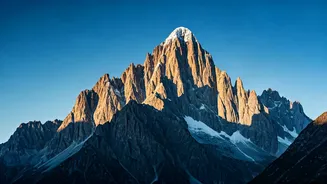

Defining Sacred Mountains
Sacred mountains, in various cultures, are not merely geological formations, but rather places steeped in spiritual significance and often viewed as the abodes
of deities or gateways to the divine. Their symbolic importance transcends mere geography, serving as focal points for religious practices, pilgrimage, and contemplation. These mountains are often associated with creation myths, where the world emerged or where gods first descended to interact with humans. They can also represent the connection between heaven and earth, with their peaks reaching towards the sky, inviting a sense of aspiration and transcendence. These mountains offer a physical and metaphysical space that fosters a deeper understanding of the divine and one's place within the cosmos. Each culture's unique interpretation gives rise to a diverse range of rituals, traditions, and artistic expressions, all reflecting the profound reverence these sites inspire. The very act of climbing a sacred mountain is seen as a way to purify the soul, to demonstrate devotion, or to come closer to enlightenment, which emphasizes the deep spiritual value they have for the people.
Mount Kailash: Tibet's Pinnacle
Mount Kailash, located in the remote Tibetan Himalayas, is perhaps the most famous and universally revered of all sacred mountains. For Hindus, it is the earthly abode of Lord Shiva, the destroyer and transformer, making it a pivotal pilgrimage site. Buddhists identify the mountain with Mount Meru, the center of the universe, and an axis mundi. Jains consider it the place where their first Tirthankara attained enlightenment. Followers of Bon, Tibet's indigenous religion, also hold Kailash sacred, associating it with spiritual power and ancestral heritage. Despite the challenging terrain and high altitude, pilgrims undertake the arduous circumambulation, known as the 'Kora', around the mountain's base to earn merit and spiritual purification. The mountain's unique shape, with its distinctive snow-covered peak, is often described as resembling a giant lingam, a symbol of Shiva, reinforcing its divine status. The surrounding landscape, including lakes Manasarovar and Rakshastal, further contributes to its sanctity, creating a powerful spiritual environment.
Mount Fuji: Japan's Icon
Mount Fuji, the iconic symbol of Japan, holds deep cultural and spiritual significance for the Japanese people. Revered for its symmetrical beauty and imposing presence, the mountain is deeply interwoven with Shinto and Buddhist beliefs. In Shinto, it is seen as a sacred place where deities dwell, and its volcanic activity is associated with the power of the gods. Buddhist traditions consider Fuji to be a gateway to another world, a place of spiritual transformation and enlightenment. For centuries, Mount Fuji has been a focus for artistic expression, inspiring countless paintings, poems, and other art forms. Climbing the mountain, especially during the pilgrimage season, is a rite of passage for many Japanese, symbolizing perseverance and devotion. Even today, the sight of Mount Fuji evokes feelings of awe, national pride, and a sense of connection to nature's power. Throughout the years, its image has become a national symbol, representing resilience and beauty.
Mount Sinai: Religious Hub
Mount Sinai, located in the Sinai Peninsula of Egypt, is primarily revered in Judaism, Christianity, and Islam. It is believed to be the site where Moses received the Ten Commandments from God, making it a cornerstone of Jewish law and ethics. The mountain holds deep spiritual significance for Christians, as it is where God revealed his laws and where Elijah encountered God. Muslims also consider Mount Sinai to be a holy site, where Allah spoke to Moses. The rugged terrain and challenging ascent add to the sense of reverence, making pilgrimage to the mountain an act of devotion and spiritual quest. The area around Mount Sinai is marked by historical sites such as St. Catherine's Monastery, one of the oldest working Christian monasteries in the world. Pilgrims and visitors come to the region to walk in the footsteps of biblical figures, reflecting on their faith and finding a connection to the divine. The historical and spiritual significance draws people from different faiths to pay homage to the historical events that unfolded there.
Mount Olympus: Greek Mythology
In Greek mythology, Mount Olympus is known as the home of the Olympian gods. This majestic peak, the highest in Greece, served as the residence of Zeus, Hera, and other major deities. Its peak was shrouded in clouds, which the ancient Greeks saw as a sign of divine presence. The very concept of Olympus embodies the notion of a celestial realm separated from the mortal world. Throughout ancient Greek culture, the gods were depicted as interacting with humans, influencing their fates, and providing insights into human nature. Mount Olympus served as the setting for countless myths and legends, representing the height of power, beauty, and wisdom. Today, the mountain continues to be a destination for hikers and history buffs, reminding people of the rich tapestry of Greek mythology. Exploring Olympus offers a journey back in time, where one can almost imagine the gods observing the mortal world.
Adam's Peak: Sri Lankan Landmark
Adam's Peak, also known as Sri Pada, is a sacred mountain in Sri Lanka, revered by Buddhists, Hindus, Muslims, and Christians. The mountain is known for its footprint-shaped impression, which is believed by Buddhists to be the footprint of the Buddha. Hindus believe it to be the footprint of Shiva, while Muslims and Christians identify it as the footprint of Adam. The pilgrimage to Adam's Peak is a significant religious event, especially during the pilgrimage season. The ascent involves climbing thousands of steps, which tests the devotion and endurance of the pilgrims. The summit offers breathtaking views, and the experience is often accompanied by the sense of spiritual accomplishment. As the sunrise occurs, the pilgrim’s faith and dedication is reaffirmed by a tangible experience. The multi-religious significance of Adam's Peak demonstrates the island's history of religious harmony, where diverse beliefs coexist and inspire spiritual journeys.