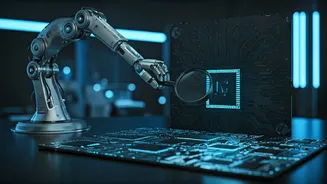








AI as Augmentation
The narrative surrounding Artificial Intelligence often sparks concerns about job displacement and the obsolescence of human skills. However, a closer
examination reveals that AI's true potential lies not in replacing human experience, but in amplifying it. Instead of viewing AI as a competitor, it's more accurate to understand it as a sophisticated collaborator. AI systems excel at processing vast amounts of data, identifying intricate patterns, and performing repetitive tasks with unparalleled speed and accuracy. This frees up human professionals to concentrate on higher-level cognitive functions such as critical thinking, creative problem-solving, strategic planning, and empathetic decision-making. For instance, in the medical field, AI can analyze diagnostic images to highlight potential anomalies, but it's the experienced radiologist who interprets these findings within the broader patient context and communicates with compassion. Similarly, in engineering, AI can optimize complex designs, but it's the seasoned engineer who applies practical knowledge and ethical considerations. This symbiotic relationship ensures that human expertise, honed through years of practice and nuanced understanding, remains indispensable, becoming even more valuable when supported by AI's analytical prowess. The focus shifts from the sheer volume of data processed to the wisdom and judgment applied to that data, a domain where human intelligence continues to reign supreme. AI, therefore, acts as a powerful catalyst, enabling individuals to achieve more and operate at a higher strategic level, thus redefining what it means to be relevant in a technologically advancing world.
Redefining Relevance
The concept of relevance in the professional sphere is undergoing a significant transformation, largely driven by the integration of Artificial Intelligence. Historically, relevance was often tied to accumulated knowledge and a deep understanding of established processes. However, with AI capable of accessing and processing information at an unprecedented scale, the emphasis is shifting towards adaptability, critical interpretation, and the ability to leverage AI tools effectively. Professionals who embrace AI as a partner will find their existing experience becoming a more potent asset. Instead of relying solely on memorized facts or established procedures, their value will be derived from their capacity to ask the right questions of AI, to validate its outputs with seasoned judgment, and to synthesize AI-generated insights into actionable strategies that align with human values and objectives. This evolution means that experience is not invalidated but is rather endowed with new dimensions. The ability to understand the nuances of a problem, to anticipate unintended consequences, and to communicate complex ideas clearly are skills that AI cannot replicate. By mastering these uniquely human capabilities and integrating them with AI's analytical power, professionals can not only maintain their relevance but also carve out new avenues for innovation and impact, ensuring their contributions remain vital and sought-after in an ever-changing professional landscape. The ongoing pursuit of learning and skill development, now incorporating AI literacy, becomes paramount for sustained professional vitality.
Future of Expertise
Looking ahead, the future of expertise will be characterized by a profound integration of human intuition and AI's computational might. It's not a scenario where AI takes over, but one where human intelligence is amplified, enabling professionals to tackle more complex challenges and unlock novel solutions. Imagine a historian using AI to sift through vast archives for obscure connections, then applying their scholarly expertise to weave a compelling narrative that AI alone could not conceive. Or consider a financial analyst leveraging AI for predictive modeling, only to use their deep market understanding and ethical compass to guide investment strategies. The key differentiator will be the ability to collaborate effectively with AI, understanding its strengths and limitations. This necessitates a continuous learning mindset, where professionals proactively seek to understand AI's capabilities and how they can be best utilized. The value of experience will not diminish; instead, it will be elevated by the capacity to interpret, contextualize, and apply AI-driven information with wisdom and foresight. This dynamic interplay promises to create a more efficient, innovative, and ultimately, more human-centric professional environment, where expertise is not just about what you know, but how intelligently you can leverage intelligent tools to achieve outcomes that were previously unimaginable.