


The Luminous Pink Moon
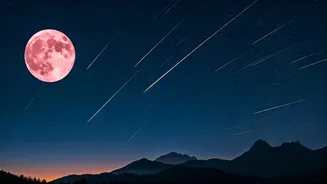
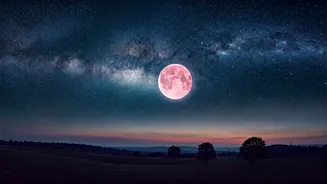
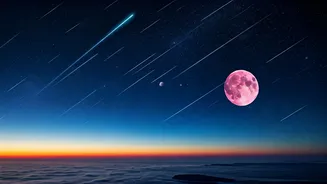
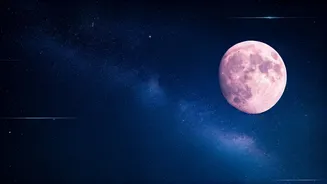
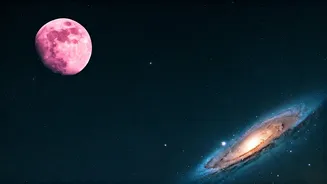
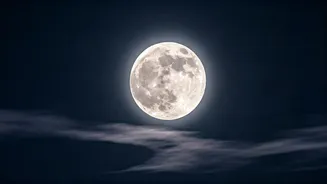
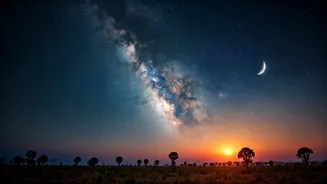
On April 1st, the first full moon of spring graces the sky at 10:12 PM ET, known as the "Pink Moon." This moniker isn't due to its color but rather its timing
with the blooming of moss pink wildflowers across North America. Furthermore, this particular full moon occurs when our lunar companion is near its closest orbital point to Earth, enhancing its appearance by approximately 15%. This proximity creates a 'supermoon' effect, making the moon appear noticeably brighter and larger, thus offering an exceptionally beautiful viewing experience for all skywatchers eager to witness its magnified glory.
Mercury's Morning Dance
Mark your calendars for April 3rd when Mercury achieves its greatest western elongation. This means the planet will be at its furthest apparent distance from the Sun when viewed from Earth, appearing distinctly in the pre-dawn sky. Typically a challenging object to spot due to its proximity to the Sun, this celestial arrangement provides an opportune moment for astronomers to observe Mercury with greater ease. This allows for more detailed study of its surface features and its incredibly thin atmosphere, offering valuable insights into this elusive inner planet.
Comet MAPS Emerges
On April 4th, Comet C/2026 A1 (MAPS) embarks on a "sun-grazing" trajectory, passing astonishingly close to the Sun, just about 850,000 miles away. As the comet ventures into the Sun's intense heat, its icy composition will vaporize, generating a brilliant, luminous coma and an extended tail. Should the comet maintain its structural integrity throughout this close encounter, it holds the potential to transform into a magnificent "Great Comet," becoming a spectacular sight visible in the early morning sky for eager observers.
Pre-Dawn Planetary Gathering
From April 16th to the 23rd, a remarkable planetary alignment will unfold in the pre-dawn sky. Mercury, Mars, Saturn, and Neptune will converge, appearing in close proximity to one another. While they may look like a tight-knit group from our perspective, these celestial bodies are separated by vast distances in space. Such rare alignments are invaluable for astronomers, offering them critical opportunities to deepen their understanding of the solar system's mechanics and to accurately calibrate their observational instruments.
Moon, Venus, Pleiades Trio
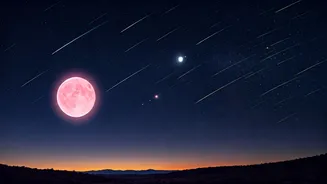
During the nights of April 18th and 19th, a particularly enchanting celestial pairing will be visible. The Moon, the planet Venus, and the well-known Pleiades star cluster will form a strikingly close conjunction. This beautiful arrangement provides a wonderful visual treat for both amateur stargazers enjoying the night sky and professional astronomers engaged in studying the intricate movements and relationships of planets and other celestial objects.
Lyrid Meteor Shower Peaks
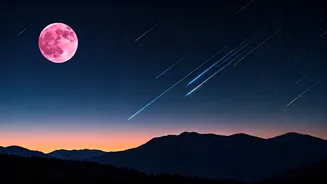
The Lyrid meteor shower reaches its peak activity on April 22nd and 23rd, originating from the debris trail left behind by Comet Thatcher. As Earth navigates through this cosmic dust stream, minuscule particles ignite upon entering our atmosphere at speeds of approximately 110,000 miles per hour, producing brilliant streaks of light. This meteor shower boasts a long observational history, dating back over 2,700 years, solidifying its status as one of humanity's oldest recognized celestial events.
Whirlpool Galaxy Showcase
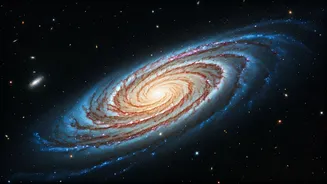
Throughout the entirety of April, the Whirlpool Galaxy, cataloged as Messier 51, will be ideally positioned for observation. Located roughly 31 million light-years from Earth, this majestic spiral galaxy is currently engaged in a gravitational dance with a smaller companion galaxy, NGC 5195. This interacting galactic pair presents an unparalleled chance for astronomers to meticulously investigate the intricate processes of star formation occurring within the prominent spiral arms of such cosmic structures.
Aurora Season's Farewell
As April draws to a close, the Northern Hemisphere experiences increasing daylight hours. This extended daylight significantly diminishes the contrast against the night sky, making it increasingly challenging to observe the ethereal Northern Lights. Despite continued solar activity that fuels the auroras, the brighter skies effectively mask these displays, signaling the traditional end of the aurora season for those residing within the Arctic Circle, a natural transition in the celestial calendar.