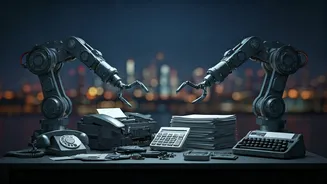








Cashiers & Ticket Clerks Fade
The role of cashiers and ticket clerks is rapidly diminishing, largely due to the proliferation of self-service technologies. Automated checkout systems
in retail environments, coupled with digital payment solutions and online booking portals for entertainment and travel, are significantly reducing the need for manual transaction handling. These automated systems can process sales and issue tickets with greater speed and accuracy than human counterparts, making traditional cashier and ticket counter positions largely redundant across various sectors, from grocery stores to public transport hubs. The convenience and efficiency offered by these digital alternatives have made them the preferred choice for both businesses and consumers alike, accelerating the decline of these frontline service roles.
Custodial Roles Evolve
While essential, jobs in building maintenance, cleaning, and housekeeping are facing a projected slowdown in growth. The increasing availability of sophisticated robotic vacuum cleaners and automated systems designed for property upkeep is beginning to offset the need for human intervention in routine maintenance tasks. Furthermore, the trend towards outsourcing these services to specialized companies, which often leverage technology and standardized processes, contributes to a reduced demand for individual custodians and housekeepers in traditional settings. This evolution suggests a shift towards more supervisory or specialized roles within the broader building care sector rather than a complete eradication of these jobs.
Print Industry Shrinks
The printing industry is experiencing a considerable downturn, primarily driven by the irreversible shift towards digital media consumption. Traditional print publications such as newspapers and magazines, along with physical advertising materials, are being increasingly superseded by their online counterparts. Consumers are now accessing news, articles, and advertisements through websites, apps, and social media platforms, leading to a sustained decrease in the demand for printed matter. This fundamental change in media habits directly impacts the workforce involved in printing operations, from press operators to pre-press technicians, resulting in a steady decline in job opportunities within this sector.
Transport Attendants Disappear
The functionality of transportation attendants and conductors is being systematically replaced by advanced ticketing and fare collection technologies. The widespread implementation of e-ticketing systems, contactless smart cards, and automated gates has made manual ticket checking largely obsolete. This technological integration is evident across various public transportation networks, including metro systems, bus services, and railways. Passengers can now seamlessly board and travel using their digital tickets or passes, eliminating the need for conductors to verify physical tickets, thus leading to the gradual phasing out of these roles.
Security Guards Replaced
The security industry is undergoing a significant transformation with the integration of artificial intelligence and advanced surveillance technology. AI-powered cameras capable of sophisticated monitoring, coupled with motion sensors and automated alert systems, are enhancing security capabilities. While human oversight remains crucial for complex situations and critical decision-making, the reliance on traditional security guards for routine monitoring and patrolling is decreasing. These technological advancements allow for more efficient and often more comprehensive security coverage, leading to a gradual reduction in the demand for on-site human guards in many environments.
Data Entry Automation
The task of data entry is highly susceptible to automation due to its repetitive and rule-based nature. Modern artificial intelligence tools are now exceptionally adept at extracting, processing, and organizing vast amounts of data with remarkable speed and precision. These AI systems can perform data entry functions significantly faster and with a lower error rate than human operators. Consequently, roles primarily focused on manual data input are diminishing as businesses increasingly adopt these intelligent software solutions to manage their information efficiently, making the job of a data entry clerk increasingly obsolete.
Postal Clerks Declining
The traditional postal service is facing a reduction in its workforce, particularly in clerical roles, due to the digital communication revolution. The widespread adoption of email, instant messaging, and other digital platforms has drastically decreased the volume of physical mail. While the delivery of parcels and packages remains a growing segment, the core clerical functions within postal services, such as sorting and processing traditional mail, are seeing a decline in demand. This shift means fewer opportunities for traditional postal clerks, even as the logistics side of the industry evolves.
Telemarketing Replaced
The practice of telemarketing, particularly cold-calling, is being increasingly superseded by more advanced and efficient communication technologies. Automated calling systems can now conduct outbound calls at scale, while sophisticated chatbots and targeted digital advertising campaigns offer more personalized and effective ways to reach potential customers. These automated and digital solutions provide better reach, engagement, and efficiency compared to traditional telemarketing efforts, leading to a reduced need for human telemarketers to engage in direct outbound sales calls.
Retail Sales Diminish
The landscape of retail sales, including street vendors, is being reshaped by the explosive growth of e-commerce. Consumers now overwhelmingly favor the convenience and vast selection offered by online shopping platforms. This shift towards digital purchasing significantly reduces the reliance on traditional brick-and-mortar sales interactions and direct selling methods. Consequently, the demand for in-person sales roles and traditional street vending is declining as more transactions migrate to the online sphere, impacting the livelihood of those in direct sales capacities.
Entry-Level Design Automated
While the creative aspect of graphic design remains a human domain, many foundational and repetitive design tasks are increasingly being handled by artificial intelligence. AI tools can now efficiently generate basic logos, design templates, and social media graphics, often faster and at a lower cost than human designers for these specific tasks. This automation primarily affects entry-level positions and roles focused on routine design work, potentially leading to fewer opportunities for aspiring graphic designers to enter the field through these traditional pathways.