



Amritsar to Attari: History on Rails
A brief 25-kilometer journey from Amritsar to Attari, costing a mere ₹10 and taking approximately 40-45 minutes, offers a profound glimpse into history
and proximity to the India-Pakistan border. The train makes intermediate stops at Chheharta and Khasa before reaching its destination. This rail line, once a vital link to Lahore before the Partition of 1947, now traces a path through visually appealing expanses of green farmland and small rural settlements. Along the way, travelers might observe training exercises of the Border Security Force near Khasa. The Attari station itself stands as a relic of the colonial era, featuring an international platform that was once bustling with cross-border train traffic. The primary draw for visitors to Attari is the renowned Attari-Wagah border ceremony. Additionally, the vicinity offers attractions such as the Sarai Amanat Khan village, Pul Kanjri established by Maharaja Ranjit Singh, and Sham Singh Attari Park, which houses a museum dedicated to the esteemed Sikh general. The train operates twice daily in each direction, with departures from Amritsar at 7:30 AM and 6:20 PM, and return services from Attari at 8:20 AM and 7:15 PM.
Amritsar to Dera Baba Nanak: A Serene Escape
Journeying from Amritsar to Dera Baba Nanak covers a distance of about 55 kilometers and takes around 1 hour and 20 minutes, with a ticket price of just ₹15. This route includes stops at Verka, Majitha, Ramdas, Rattar Chattar, and Hardowal before arriving at the significant town in the Gurdaspur district. The stations along this path are characterized by their charming colonial-era architecture, often adorned with vibrant bougainvillea. Verka station, in particular, evokes the ambiance of a hill-station bungalow, while Hardowal presents a tranquil rural setting. Through the carriage windows, passengers are treated to expansive views of cultivated fields, tractors at work, and villagers engaged in their daily routines across the picturesque countryside. Dera Baba Nanak is a place of immense spiritual importance, marking the final years of Guru Nanak Dev Ji's life. The town is situated across the Ravi River from Kartarpur in Pakistan, home to the revered Gurdwara Darbar Sahib Kartarpur. A key attraction here is the Kartarpur Corridor, which, when operational, permits Indian Sikh pilgrims visa-free access to the shrine in Pakistan. Other notable sites include the Darbar Sahib gurdwara, Sri Chohla Sahib, and the local marketplace. The train service offers multiple daily options: departures from Amritsar/Verka to Dera Baba Nanak at 4:20 AM, 10:30 AM, 2:15 PM, and 5:50 PM, with return journeys available at 6:05 AM, 12:15 PM, 4:00 PM, and 7:20 PM.
Amritsar to Khem Karan: Echoes of War
The most extensive of the three routes, the 77-kilometer journey from Amritsar to Khem Karan, requires approximately two hours to complete and is priced at ₹20. Some services originate from Bhagtanwala station, located near Amritsar. The train traverses through numerous small halts in the Taran Taran district, providing an intimate perspective of rural Punjabi life. Khem Karan holds significant historical importance as the site of the pivotal Battle of Asal Uttar during the 1965 Indo-Pakistani War. It was here that Indian forces successfully repelled a major Pakistani armored offensive, leaving behind destroyed tanks that gave the area the grim moniker, the “Graveyard of Tanks.” Notable sites near the border fence include Gurdwara Sahib Singh Shaheed and Sheikh Braham Dargah. Access to these shrines necessitates passing through Border Security Force checkpoints. Strict regulations are in place, including the confiscation of electronic devices and a prohibition on photography in the vicinity. Train schedules from Amritsar/Bhagtanwala to Khem Karan are: 4:40 AM, 9:15 AM, 1:35 PM, and 6:10 PM. Return services depart at 6:50 AM, 11:25 AM, 3:35 PM, and 8:10 PM.
Cinema and Countryside Charm
The railway corridor between Amritsar and Attari has not only served as a historical conduit but also as a backdrop for Indian cinema, infusing the landscape with narrative depth. The tracks themselves featured prominently in the film 'Bajrangi Bhaijaan,' underscoring the emotional ties that transcend the physical border between India and Pakistan. Attari station, with its evocative atmosphere, was a filming location for 'Veer-Zaara,' a cinematic exploration of love that defied national boundaries. This quiet frontier station and its railway line continue to resonate with themes of separation and remembrance. The unassuming railway station at Dera Baba Nanak has also found its way into the realm of filmmaking, recently appearing in 'Gustaakh Ishq,' a production that celebrated the idyllic charm of smaller Punjabi towns and their vintage railway architecture. These cinematic portrayals highlight the enduring allure of these routes, blending scenic beauty with powerful storytelling.
Winter's Embrace on Rails
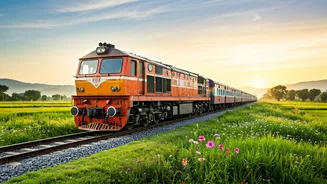
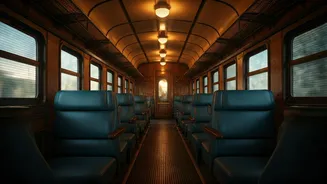
Traversing these routes during the winter months unveils a particularly enchanting spectacle, transforming the landscape into a dreamlike panorama. December mornings are often characterized by a dense fog that blankets the fields surrounding Amritsar and Attari, softening the verdant hues of the countryside into muted shades of grey and green. As the train glides forward, the expansive farmlands, distant hamlets, and the vast, open sky combine to create a serene and unfolding tableau visible through the train windows. This ethereal atmosphere adds a unique layer of beauty to the journey, making it a truly memorable experience for those who choose to travel during this season. The quiet charm of the rural settings is amplified by the gentle haze, offering a tranquil escape.
Sacred Sites Near the Border
The sacred sites situated in close proximity to the Khem Karan border fence present a unique opportunity for pilgrimage, albeit one that involves a stringent security protocol. Visitors are required to pass through multiple Border Security Force (BSF) checkpoints and must carry valid identification documents to gain entry. A crucial aspect of the security measures mandates the surrender of all electronic devices, including mobile phones and cameras, to the BSF before proceeding towards the shrine area. Furthermore, photography is strictly prohibited in the vicinity of the international border fence, ensuring the security and sanctity of the sensitive region. These measures, while requiring adherence, allow access to significant religious landmarks that hold deep meaning for many.
Architectural Heritage Stations
Many of the railway stations dotting these scenic routes are enduring testaments to colonial-era architectural styles. While some of these historic structures have unfortunately fallen into disrepair or have been demolished—such as the former stations at Chheharta and Khasa on the Attari route—the surviving buildings continue to captivate. The stations along the Dera Baba Nanak line, in particular, retain their visual appeal and possess the potential to be revitalized as heritage attractions, drawing visitors keen to experience a bygone era. These stations offer more than just transit points; they are living monuments that connect the present to the past, providing a tangible link to India's railway history and architectural legacy.