






A New Era in Robotics
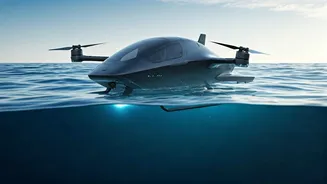
India has achieved a significant technological milestone with the introduction of 'Avataar,' the nation's inaugural amphibious drone. Developed by AquaAirX
Autonomous Systems, a Bengaluru-based firm specializing in autonomous vehicles for challenging environments, Avataar represents a paradigm shift in robotics and surveillance. This innovative machine is engineered to operate with equal proficiency in the air and beneath the water's surface, a capability that dramatically expands the potential for reconnaissance and data collection. The project received crucial early-stage funding from Rainmatter, an organization dedicated to fostering technological advancements. Avataar's unique design allows for a fluid transition from soaring through the skies as a conventional unmanned aerial vehicle (UAV) to gracefully submerging and operating in aquatic environments, a dual-domain mastery previously unattainable by a single platform. This advancement is poised to revolutionize operations for sectors like defense and scientific research, offering unprecedented versatility and operational reach. The drone's development is a testament to India's growing prowess in advanced robotics and multi-domain system integration.
Robust Design for Harsh Conditions
The 'Avataar' drone is meticulously crafted to withstand the rigors of both aerial and underwater operations, particularly in corrosive marine settings. Its airframe is constructed from carbon fiber, a material chosen for its inherent strength and resistance to saltwater, thereby preventing corrosion. Furthermore, specialized coatings are applied to the drone's exterior, designed to repel salt deposits and any sensor-fouling grime that might accumulate during its missions. This attention to material science and protective finishes ensures the drone's longevity and operational integrity even in the most demanding oceanographic and coastal environments. The successful development and testing of Avataar has led it to achieve Technology Readiness Level 6 (TRL 6). This crucial milestone signifies that the drone is well beyond the conceptual or laboratory prototype stage, having undergone rigorous validation in real-world conditions. It has successfully navigated actual water bodies, enduring the unpredictable forces of currents and pressure, proving its robust functionality and readiness for advanced trials and eventual deployment.
Intelligent Navigation and Communication
Avataar's operational prowess is amplified by its sophisticated autonomous capabilities, enabling it to perform complex tasks without continuous human intervention. Its primary function involves seamless transitions between aerial observation and underwater exploration, offering a comprehensive surveillance solution. For maritime applications, this means the drone can visually track vessels from above and then submerge to inspect their hulls or detect submerged threats. To maintain precise positioning in dynamic water currents, Avataar employs an intelligent speed monitoring system. This system continuously tracks the drone's velocity and its relative position to the seabed, ensuring it maintains situational awareness and avoids unwanted drift. Communication with the surface is achieved through an innovative underwater acoustic modem, effectively creating an 'underwater Wi-Fi' that transmits data and commands without the need for physical tethers. For its return journey, a sophisticated internal timer calculates the precise distance and direction back to its base, allowing for autonomous navigation and recovery. These integrated technologies empower Avataar to execute challenging missions independently, from surface wave analysis to deep-sea exploration, making it an invaluable asset for future monitoring and research endeavors.