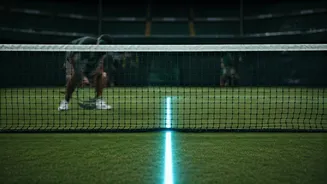









Major Tech Overhaul
The All England Club has announced a groundbreaking shift, confirming the introduction of sophisticated video review technology for line calls, commencing
with the 2026 tournament. This move places Wimbledon in lockstep with the Australian Open and the US Open, both of which have already integrated similar systems. The implementation will utilize Hawk-Eye Live, a system renowned for its automatic line-calling capabilities, across every court utilized for the prestigious Grand Slam event. This decision represents a notable departure from Wimbledon's historical tendency to adopt new technological advancements at a more gradual pace compared to its fellow major championships. The commitment to this upgrade follows rigorous testing phases and incorporates valuable input from both professional players and tournament officials, signaling a proactive approach to improving the game. Ultimately, this integration is poised to significantly streamline the officiating process and elevate the overall player experience on court.
Automated Decisions Ahead
With the advent of Hawk-Eye Live, the traditional role of human line judges for making line calls will be phased out entirely. The advanced system is engineered to deliver instant and highly accurate judgments, thereby accelerating the pace of play and potentially reducing the frequency of player challenges. Sally Bolton, the Chief Executive of the All England Club, expressed enthusiasm for the technological integration, stating, "We are always looking for ways to enhance the fairness and accuracy of our sport, and we believe that Hawk-Eye Live will be a valuable addition to Wimbledon." This sentiment underscores the club's commitment to progress and its belief in the technology's capacity to benefit the sport. By 2026, this transition means that all four Grand Slam tournaments will feature automated line-calling systems, creating a consistent standard across the sport's pinnacle events.
Lessons from the Past
Wimbledon's journey towards automated line-calling wasn't without its initial hurdles. In the preceding year, the tournament had already made a significant change by removing line judges after 176 years and introducing the Electronic Line Calling (ELC) system. However, this transition revealed some early challenges. Notably, player Emma Raducanu, competing in a high-profile match, attributed a crucial loss to perceived inaccuracies in the ELC system. She voiced her disappointment, commenting, 'It’s kind of disappointing, the tournament here, that the calls can be so wrong, but for the most part they’ve been OK. I’ve had a few in my other matches, too, that have been very wrong. Hopefully they can fix that.' Fellow British player Jack Draper also echoed similar concerns regarding the ELC's decision-making. A particularly striking instance involved Anastasia Pavlyuchenkova's match, where a disputed volley call by the ELC led to confusion and a point replay, as the system was reportedly not active at that precise moment, prompting Pavlyuchenkova to express that the 'game was stolen from her.'
VRT Capabilities Explored
The Video Review Technology (VRT) is already a familiar feature in two of the four Grand Slams and various ATP/WTA 1000 events, and its integration at Wimbledon will extend its presence. The system will be accessible on six courts, empowering players with the ability to contest specific rulings made by the chair umpire. Players will be granted an unlimited number of reviews, offering considerable flexibility. Centre Court and Court No. 1 will benefit from this technology throughout the entire tournament, while Courts 2, 3, 12, and 18 will offer VRT access until the conclusion of singles matches on those respective courts. This technology can be applied to a range of calls, including 'double bounces,' whether a racket or player has contacted the net, and 'hindrance' calls. Wimbledon has clarified that players can request a review for umpire judgment calls like 'not-up,' 'foul shot,' or 'touch,' either immediately after a point-ending call or when play is halted, or promptly after a point concludes in instances of hindrance. The review process will either confirm or overturn the original adjudication.
Hindrance Calls Evolve
The inclusion of hindrance calls under the VRT umbrella introduces a new layer of complexity and potential for controversy. An incident involving Jack Draper at Indian Wells, where he lost to Daniil Medvedev, highlighted these challenges. During a rally, Draper expressed frustration, believing a ball had landed beyond the baseline, and raised his hands. Medvedev, however, continued the rally and won the point. Subsequently, Medvedev appealed to the chair umpire for a hindrance call, which was awarded in his favor despite the outcome of the point being seemingly unaffected by any hindrance he might have experienced earlier. This scenario underscored how VRT could, in certain situations, become an outcome-dependent system, where a player might only invoke a hindrance call if it proves beneficial to their advantage, raising questions about the purity of the system's intent to ensure perfect officiating.
French Open's Stance
Amidst the widespread adoption of advanced technology in tennis, the French Open remains the sole Grand Slam tournament that has not yet integrated video review systems. Roland Garros continues to rely on human line judges and has yet to embrace VRT. Reports from BBC Sport suggest that the French Open's hesitance stems from a deep-seated adherence to a system that has been in place for 134 years, combined with a resistance to relinquishing human control over officiating. Gilles Moretton, president of the French Tennis Federation (FFT), has articulated this perspective, stating, 'I think we are right to keep our referees and line judges at Roland Garros. The federation wants to keep our referees for as long as we can. I hope we’ll be able to maintain it in our tournaments in the future.' This position highlights a divergence in philosophy regarding the role of technology in maintaining the sport's traditions and the human element of competition.