







Origins and History
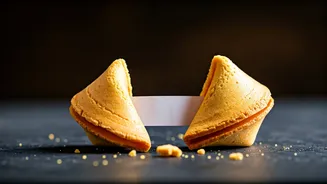
The origin of the fortune cookie isn't as clear-cut as the messages they contain. While commonly associated with Chinese cuisine, their precise roots are
a subject of debate. The prevailing theory suggests that the fortune cookie originated in Japan, not China. Evidence points towards a Japanese confection called 'tsujiura senbei,' a slightly larger and darker cookie with a fortune tucked inside. This treat was reportedly served in temples and shrines. Over time, Japanese immigrants brought this concept to the United States, and it gained popularity. The cookies were then adapted to suit American tastes, becoming sweeter and taking on the familiar shape we know today. This transformation demonstrates a fascinating journey of cultural exchange and adaptation, where a Japanese tradition evolved into a global phenomenon.
Cultural Significance
Fortune cookies have become a ubiquitous part of the dining experience, especially in the West. They're often seen as a fun way to end a meal, offering a moment of lighthearted prediction or inspiration. The messages inside can range from simple proverbs and inspirational quotes to vague predictions about the future. This makes them a form of entertainment, sparking conversation and sharing. They are used in countless settings, from casual family dinners to more formal events. They have also become integrated into popular culture, appearing in movies, television shows, and other forms of media. The cookies have become a symbol of Chinese cuisine. The reality, however, is that this iconic treat, steeped in mystery and intrigue, is far more complex than it initially appears. It represents a cultural hybrid, a testament to the exchange of ideas that takes place within different cultures.
Messages and Interpretations
The contents of a fortune cookie are meant to offer a moment of reflection or a bit of amusement. The fortunes themselves can be interpreted in numerous ways. Some people treat them as a source of serious guidance, carefully considering the advice given. Others see them as a fun game, a chance to contemplate the possibilities of the future. The ambiguity of the messages allows for a wide range of interpretations, making them relatable to people from all walks of life. The messages are designed to be general enough that they can apply to various circumstances. The element of personalization allows people to connect with the fortunes and find meaning in them. Whether it is taken seriously or not, the fortune adds an element of surprise and anticipation, contributing to the experience. The simplicity of the fortunes ensures that they remain engaging, contributing to the enduring popularity of the cookies.
The Global Journey
The journey of the fortune cookie from its Japanese origins to its global presence is a fascinating tale of cultural adaptation and commercial success. It's a reminder of how cultural traditions can evolve as they travel. Today, fortune cookies are enjoyed worldwide, regardless of cultural background. This is a testament to the universal appeal of these sweet treats. They've become a symbol of both Chinese cuisine and the American dining experience. The cookies have been embraced by various cultures. They showcase the way in which food can transcend geographical boundaries, creating shared experiences and moments of joy. This global spread makes the fortune cookie a case study in the power of cultural exchange. From a small Japanese sweet to a global dessert, it represents the dynamic nature of cultural transmission.